Student pilot flies solo over Hà Giang's Rocky Plateau
In August he was still learning to inflate a wing on the grass at Khau Phạ pass. By November, Tài, a flying enthusiast from Saigon, was flying solo above the cat's-ear limestone peaks of Hà Giang's Rocky Plateau with his own kit: an Advance Alpha 7 wing, an Advance Boundless harness, a NOVA Pentagon reserve, a helmet and a radio.
November and December at Quản Bạ bring dry, clear skies, long views, morning seas of clouds and early sunsets. Which flight to choose, when to fly, what to wear in the cold and how to book for the year-end holidays…
A breakdown of the strengths and weaknesses of paragliding and paramotor flights in Quan Ba: which time of day suits which, and which type of traveller fits PG and which fits PPG, and why…
Everything you need to know about paragliding in Hà Giang: the Quản Bạ and Đồng Văn sites, paragliding and paramotor prices, flying hours, who can fly, and booking with no deposit…
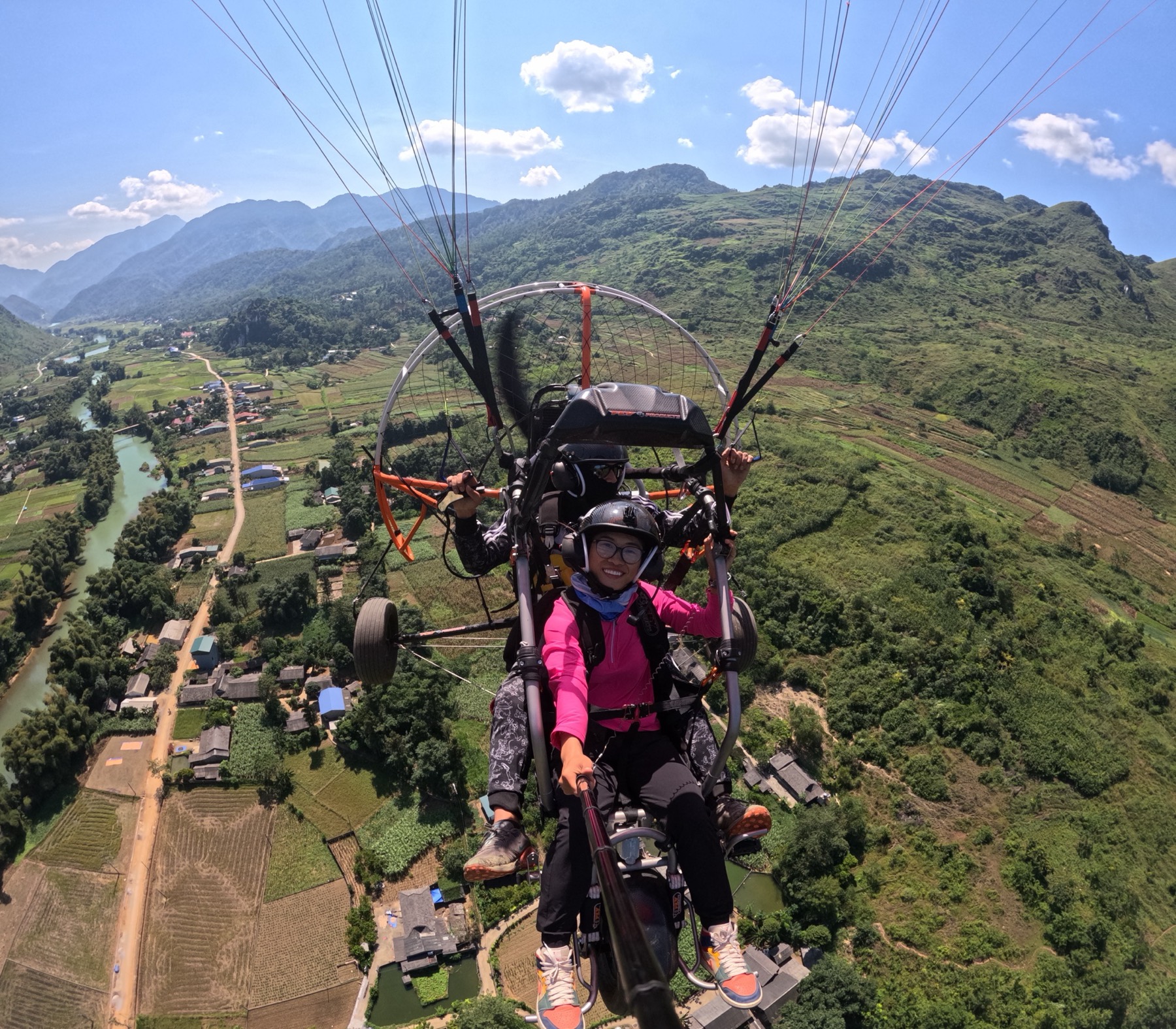
Sit in a wheeled powered paraglider, roll along the bank of the Miện River and lift off over the Quản Bạ valley, the Cán Tỷ gorge and the sharp tai mèo limestone peaks of Hà Giang's Rocky Plateau. What a paramotor is, how a flight goes, who can fly and how it differs from paragliding…
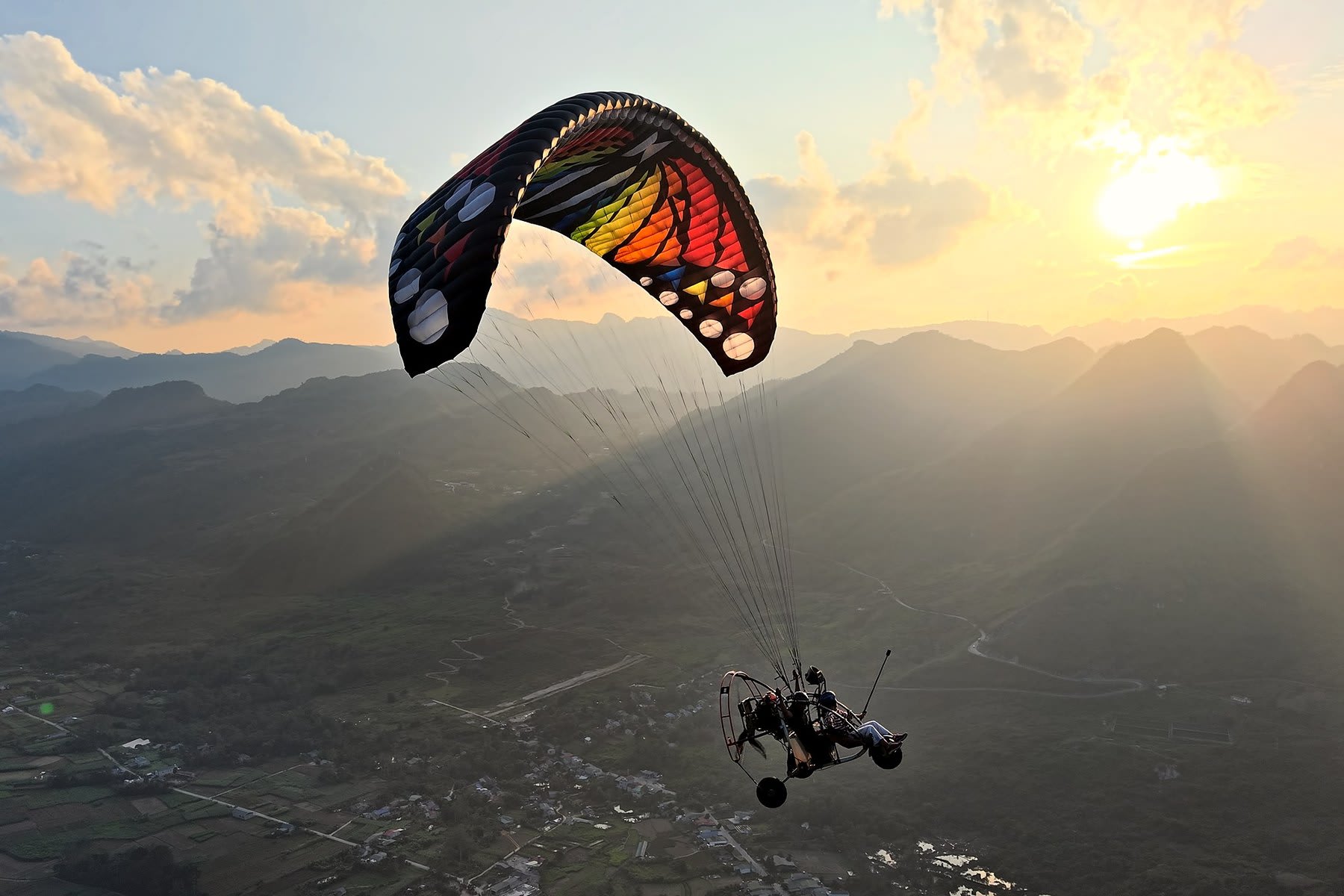
A 22–25 minute sunset paramotor flight in Hà Giang: take-off right beside the Miện river, then over the Lùng Tám – Tráng Kìm valley, the Cán Tỷ gorge and the sheer cliffs of the Rocky Plateau in the late-afternoon sun…
What paragliding is there in Hà Giang today? Daily tandem paragliding and paramotor flights at Quản Bạ, sunset flights, cloud chasing, Đồng Văn paragliding by appointment, the pilots' training days and the festivals that have put wings in Hà Giang's sky. With drone photos of one whole tandem flight at midday on 15 November 2026, prices and how to join…
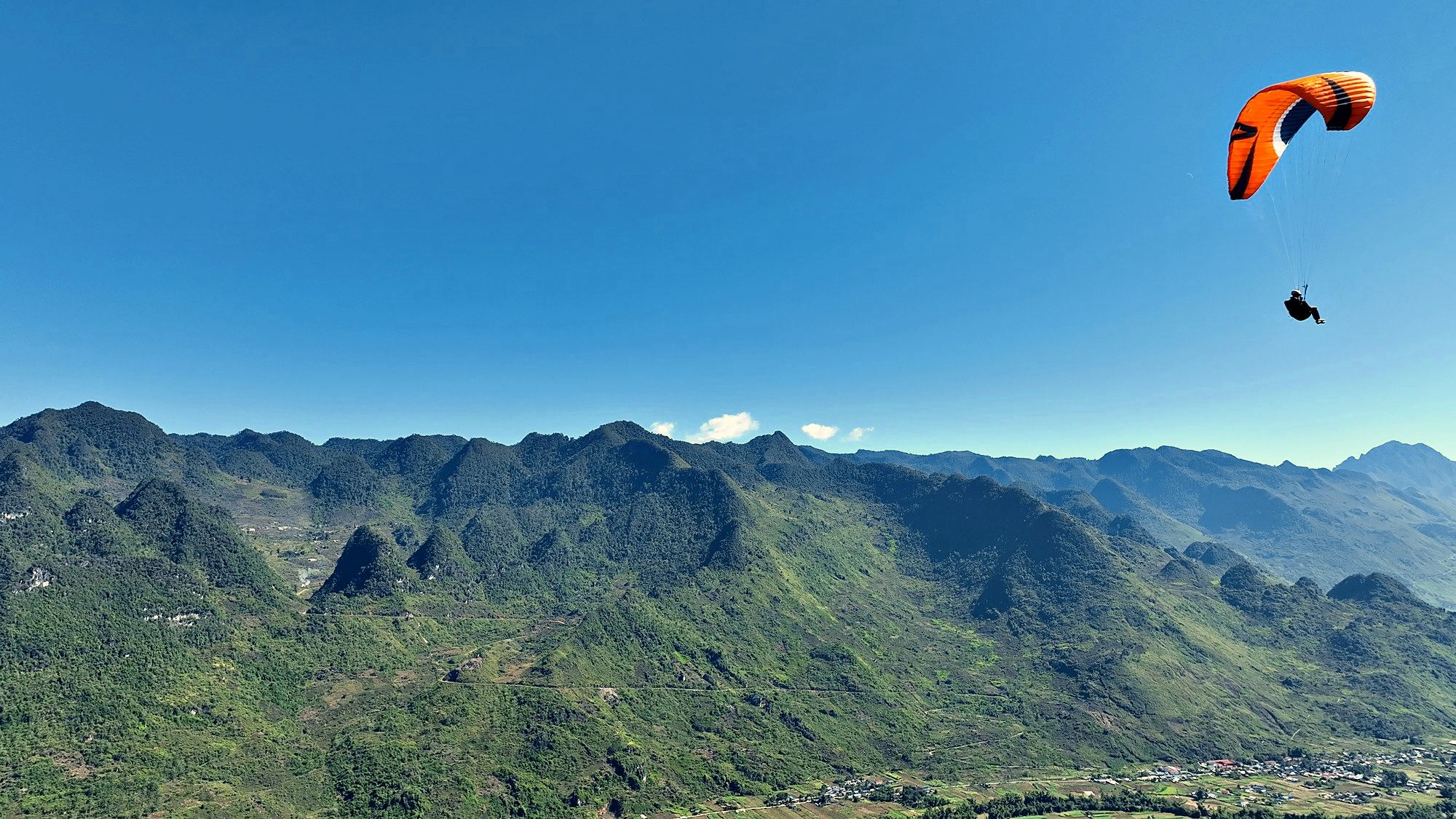
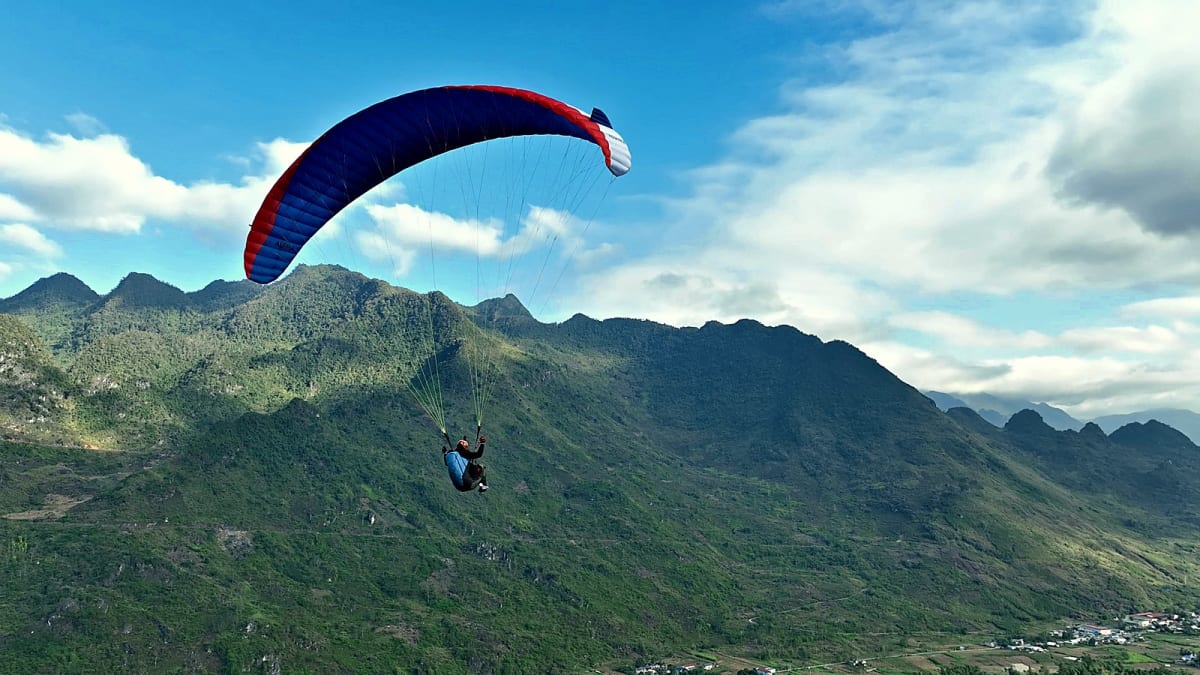
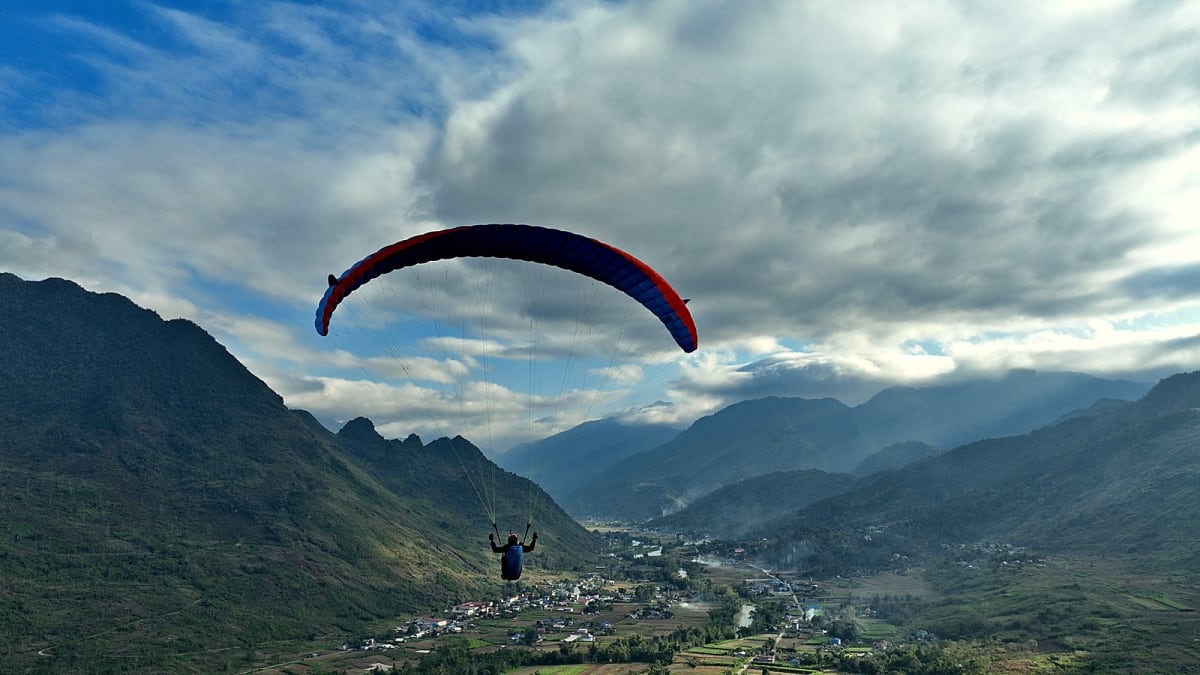
On the afternoon of 22 November 2026, a blue, red and white wing drifted alone above the sharp "cat's-ear" limestone peaks of Quản Bạ, between a clear blue sky and white clouds. Hanging beneath it was Tài, a flying enthusiast from Saigon. Three months earlier, he had still been practising pulling a wing up over his head on a grassy slope at Khau Phạ pass.
This time he came to Hà Giang with gear of his own: wing, harness, reserve parachute, helmet and radio. On the afternoons of 21 and 22 November, he launched, flew and landed by himself over Hà Giang's Rocky Plateau, going from student to solo pilot under his own wing.
Tài flying solo over the cat's-ear limestone ridges of Quản Bạ, 22 November 2026.
From Saigon to Khau Phạ pass
Driven by his love of flying, Tài travelled north from Saigon in August 2026 and signed up for Mebayluon's paragliding course at Khau Phạ pass.
Mebayluon's P1–P2 beginner course takes about 5–7 days, depending on the weather. Students work through the steps one by one:
Theory: wind and weather, how a wing and harness are built, the rules of the air, how to handle the unexpected.
Ground handling (controlling the wing on the ground): pulling the wing up overhead, keeping it steady, bringing it back down, again and again, hundreds of times.
Low hops on a gentle slope: a few running steps down a small hill, leaving the ground, flying a few dozen metres, then landing.
The first high flight: taking off from a launch site on the mountain, with an instructor guiding by radio all the way from take-off to the landing field.
The training path and certificates are explained in detail in the post P1–P2 paragliding course on mebayluon.com. If you are just starting to look into it, the post learning to fly a paraglider solo answers the first questions: where to learn, how long it takes, and what fitness you need.
Once the course was over, Tài didn't put flying away. He began flying on his own and building up his first solo flights. To do that, he bought a set of gear of his own.
Tài's own gear
During the course, students use the school's equipment. To keep flying for the long run, a pilot needs gear of their own that suits their weight and level. Tài chose each piece one at a time:
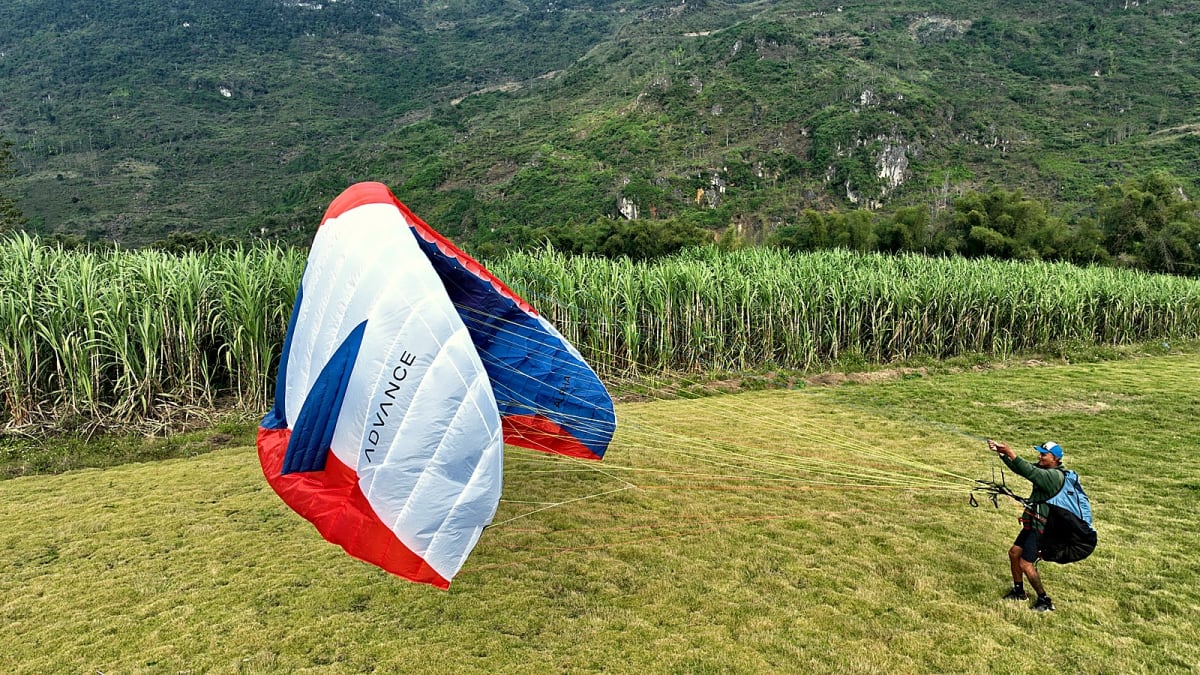
An Advance Alpha 7 wing, made by Advance in Switzerland. It is an EN-A wing, the safest certification class, designed for beginners: easy to inflate, easy to steer, and stable in bumpy air. ADVANCE is printed across the top surface, so his blue, red and white wing is easy to spot from far away.
An Advance Boundless harness in Azur blue, also by Advance. The harness is the seat that hangs beneath the wing, with back protection and a pocket for the reserve parachute. The Boundless has a built-in backpack: there is no turning it inside out like reversible harnesses, because the rucksack that carries the wing is the back of the harness in flight. Advance designed it for pilots from their very first years all the way to cross-country flights.
A NOVA Pentagon reserve parachute, made by NOVA in Austria. This is the emergency parachute, packed inside the harness and thrown only if something goes wrong. The Pentagon has five sides, opens quickly and swings little once deployed.
A helmet made specifically for paragliding.
A radio, to stay in touch with the pilot on the ground throughout the flight.
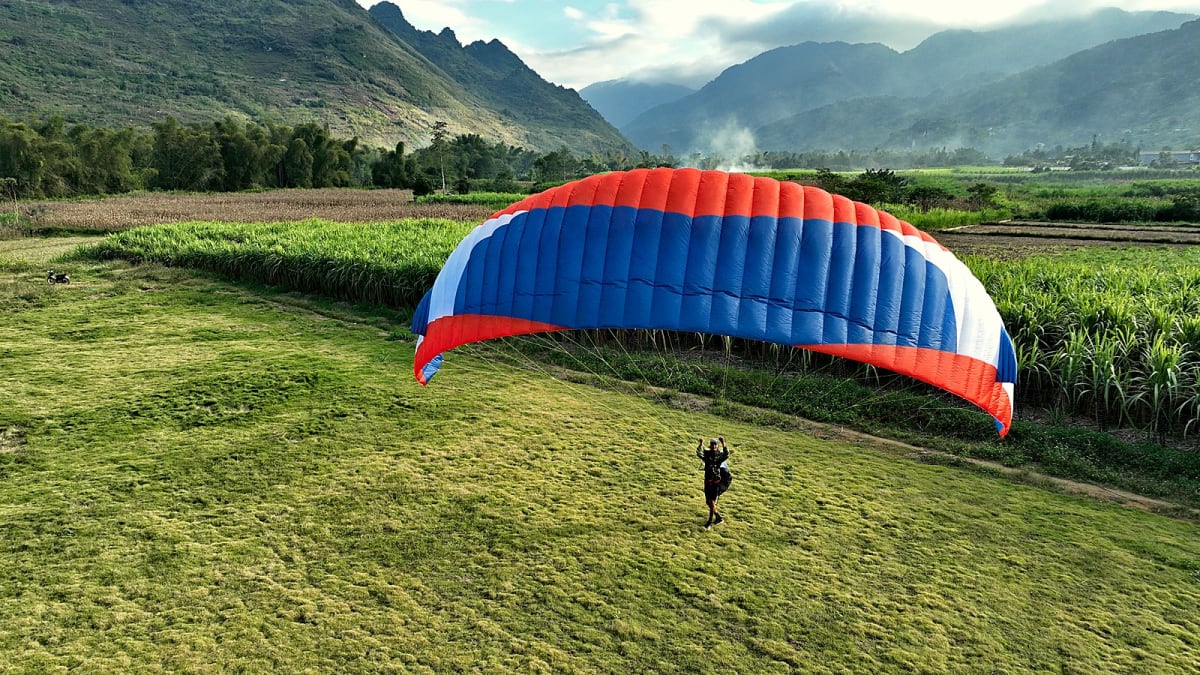
The ADVANCE lettering on the Alpha 7, as Tài practises inflating his wing on the landing field on the bank of the Miện River (22 November 2026).
A kit like this belongs to one person. Its pilot knows every line, every buckle, and when the reserve was last repacked. A reserve has to be repacked at regular intervals, as the manufacturer recommends, even if it has never been thrown.
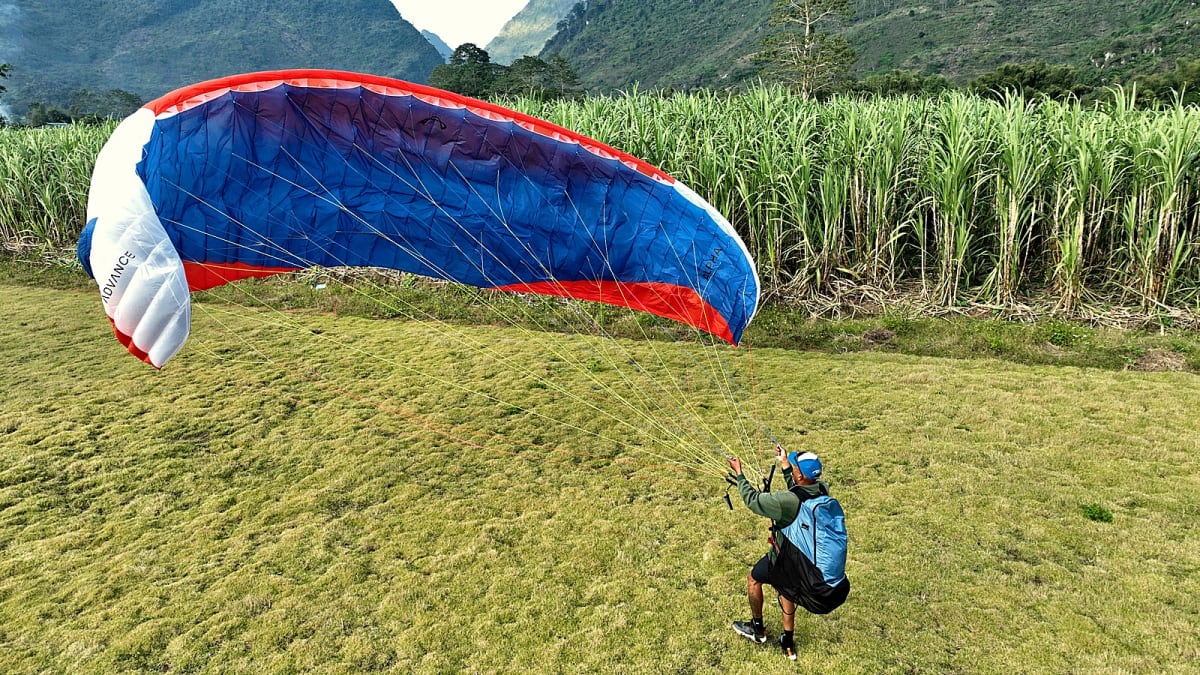
Facing the wing, lines in hand, an even pull: the exercise students repeat more than any other (Quản Bạ, 22 November 2026).
Ground practice in front of the limestone ridges
Pilots like to joke that good flying starts on the ground. If you can't master your wing on a grassy field, you'll struggle to master it in the sky. So after every flight, Tài spread his wing out on the landing field again and kept practising.
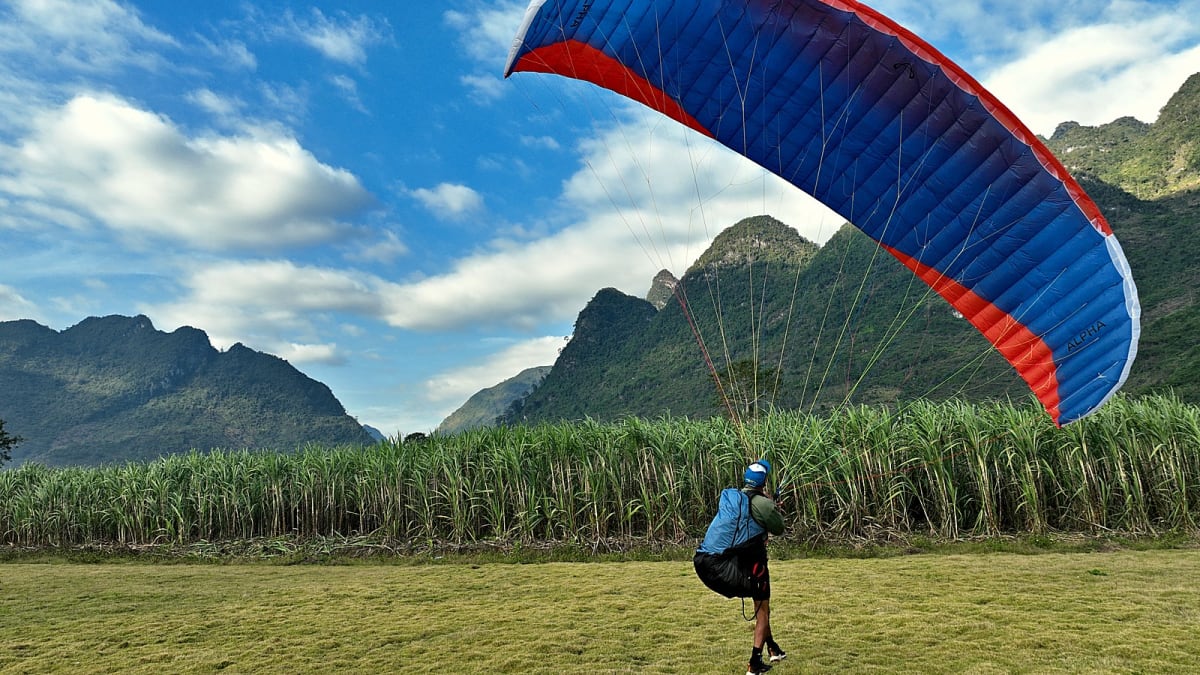
The drill has three parts: face the wing and pull it up overhead, hold it steady in the wind, then let it come back down. Sometimes the wing tipped to one side and leaned right over. He stepped with it, worked the brakes and brought it back to the centre. Then he did it again, over and over.
The wing rises in front of the limestone ridges that ring the Quản Bạ valley (22 November 2026).Holding the wing steady overhead is a skill you need before every take-off (landing field on the bank of the Miện River, 22 November 2026).
Afternoon of 21 November: first take-off at Quản Bạ
The paragliding take-off at Quản Bạ sits on the mountainside, at about 950 m. The landing field lies down in the valley, on the bank of the Miện River, at about 450 m. Those 500 metres in between are a whole stretch of sky for a student to practise in.
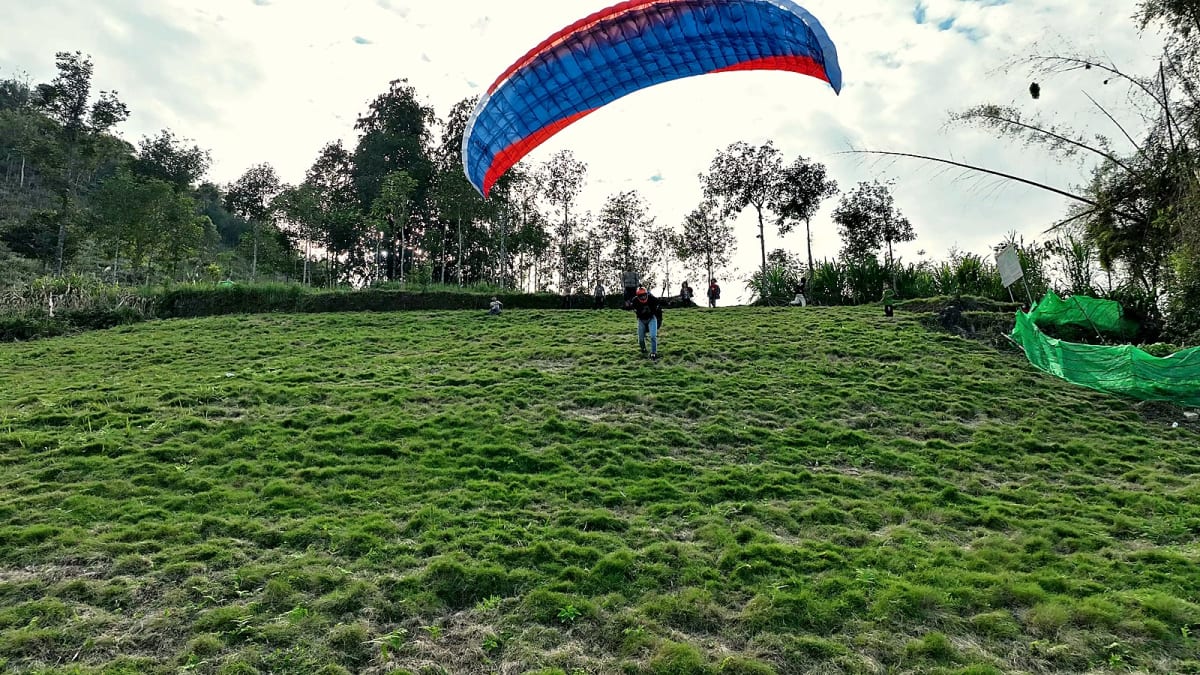
Before taking off, Tài double-checked his harness, buckles, lines, reserve and radio, then laid his wing out on the grass. The Mebayluon pilot at take-off watched the wind and the sky and told him when the moment was right.
Tài inflates his wing at the Quản Bạ take-off, turns around and gets ready to run (21 November 2026).The take-off on the mountainside, at about 950 m (21 November 2026).
A few running steps, the wing lifts him, and his feet leave the ground. Ahead lies the Quản Bạ valley, the town at the foot of the mountains, and ridge after ridge of rock layered all the way to the horizon. Throughout the flight, the radio kept him in touch with the pilot on the ground.
The first minutes after leaving take-off, with Quản Bạ town right beneath his feet (21 November 2026).
Afternoon of 22 November: a clear day
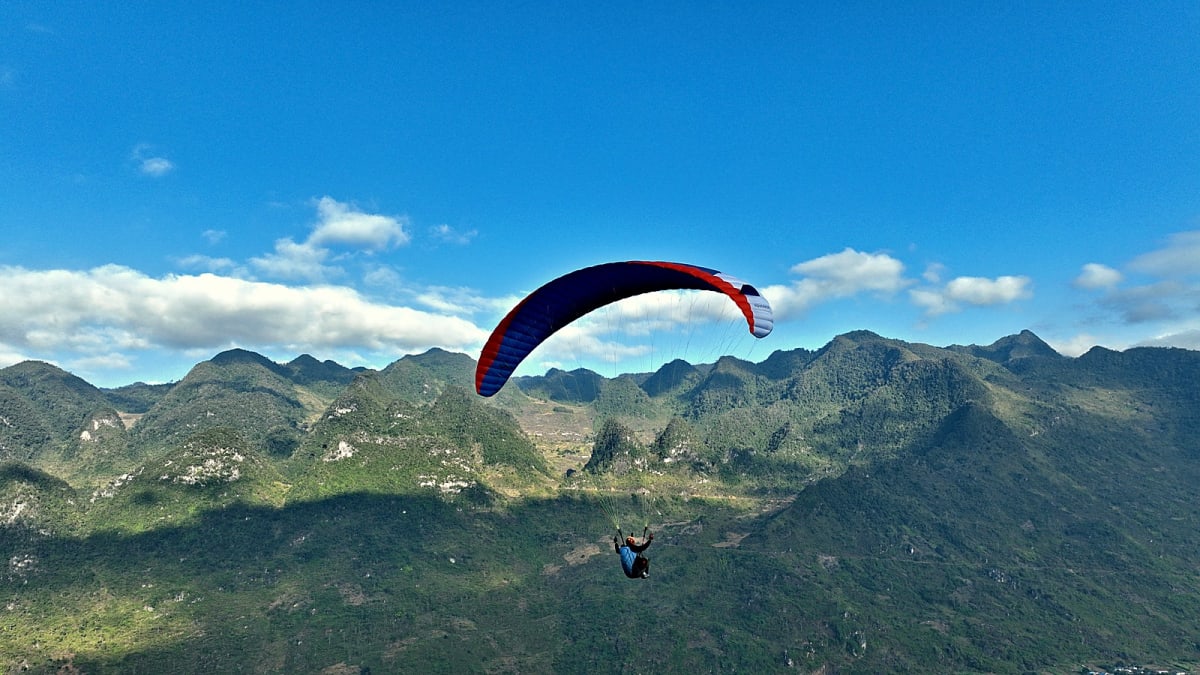
On the afternoon of 22 November, the sky over Quản Bạ was blue, with white clouds drifting slowly over the cat's-ear peaks. It was the kind of afternoon every pilot hopes for.
Tài flew out over the valley, then circled back above the peaks. From up high, the jagged ridges ran into one another like a sea of stone, and his wing was the only splash of colour in the sky.
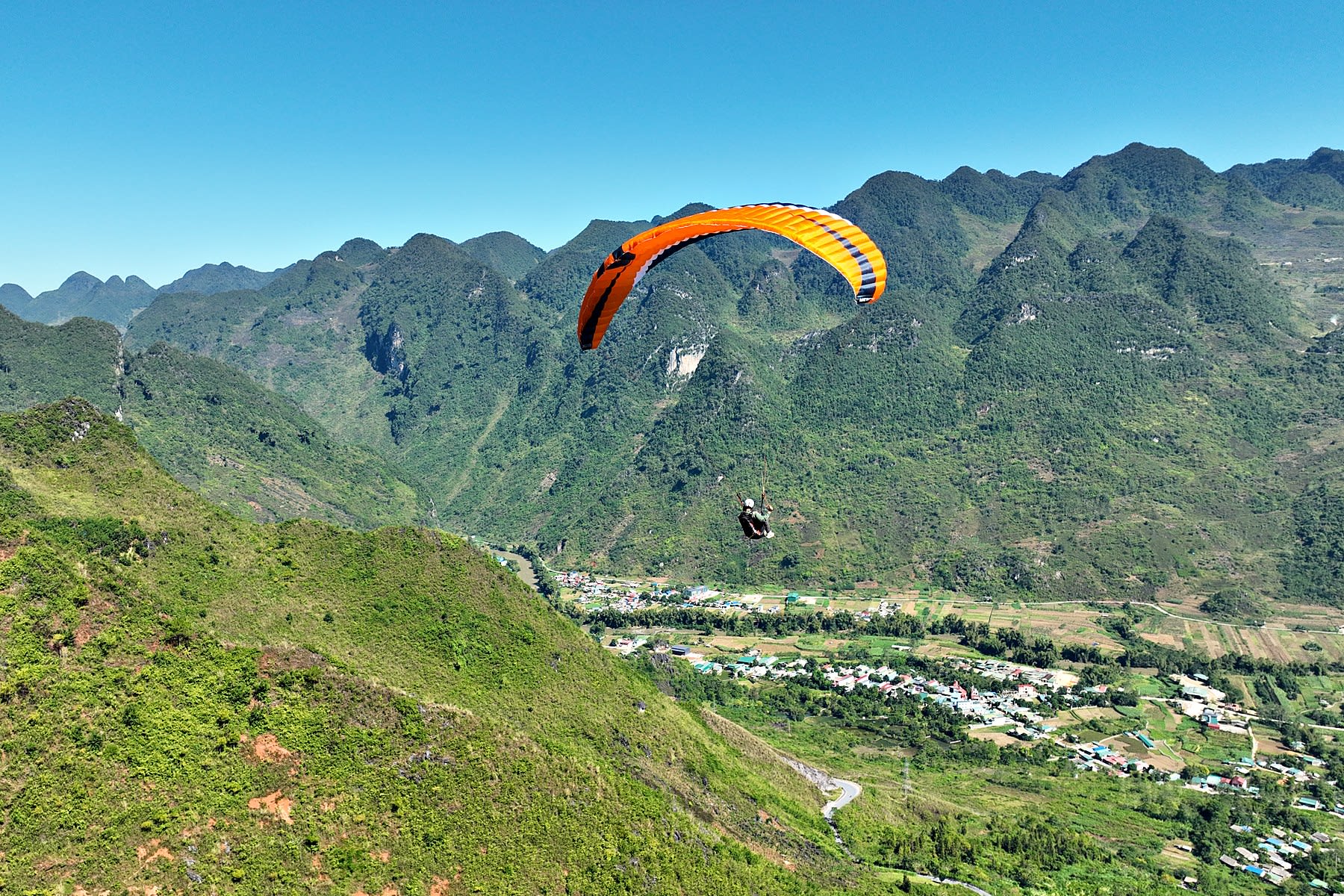
One pilot, one wing, above the cat's-ear limestone ridges (Quản Bạ, 22 November 2026).Tài flies past the drone, with the mountains and blue sky behind him (22 November 2026).Clear sky, gentle wind: a fine afternoon for building up airtime (22 November 2026).
On the far side, clouds rolled in over the head of the valley. The afternoon sun broke through them, lighting up the rooftops and fields at the foot of the mountains.
Afternoon clouds over the head of the Quản Bạ valley (22 November 2026).
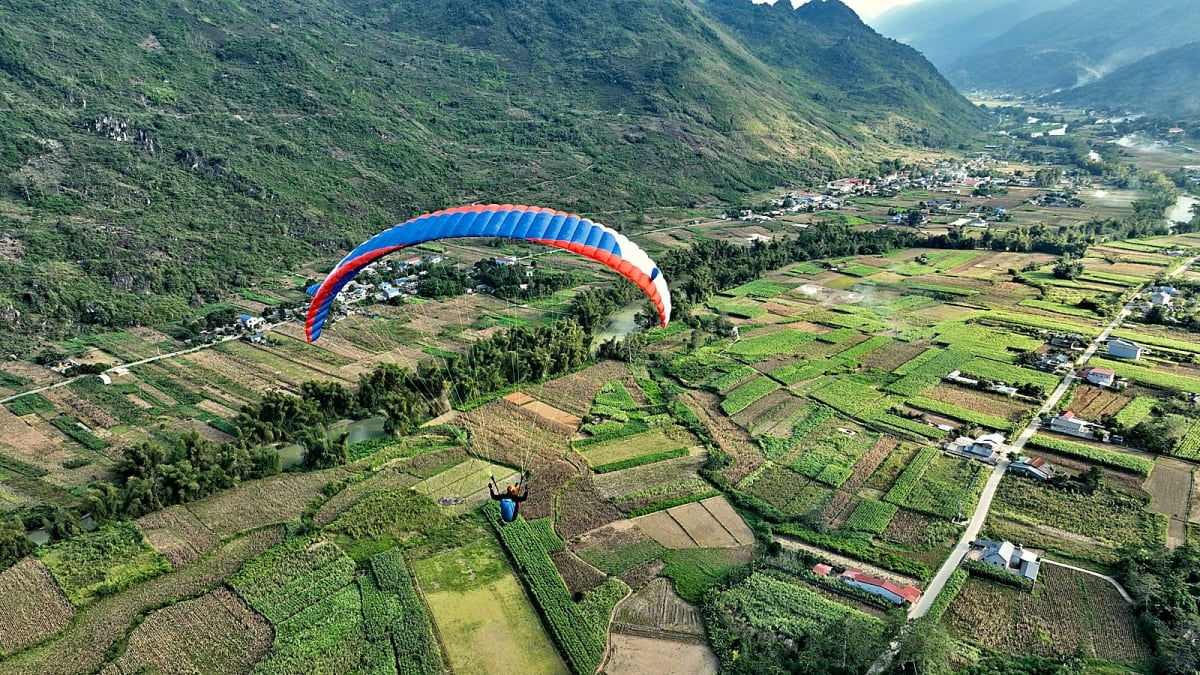
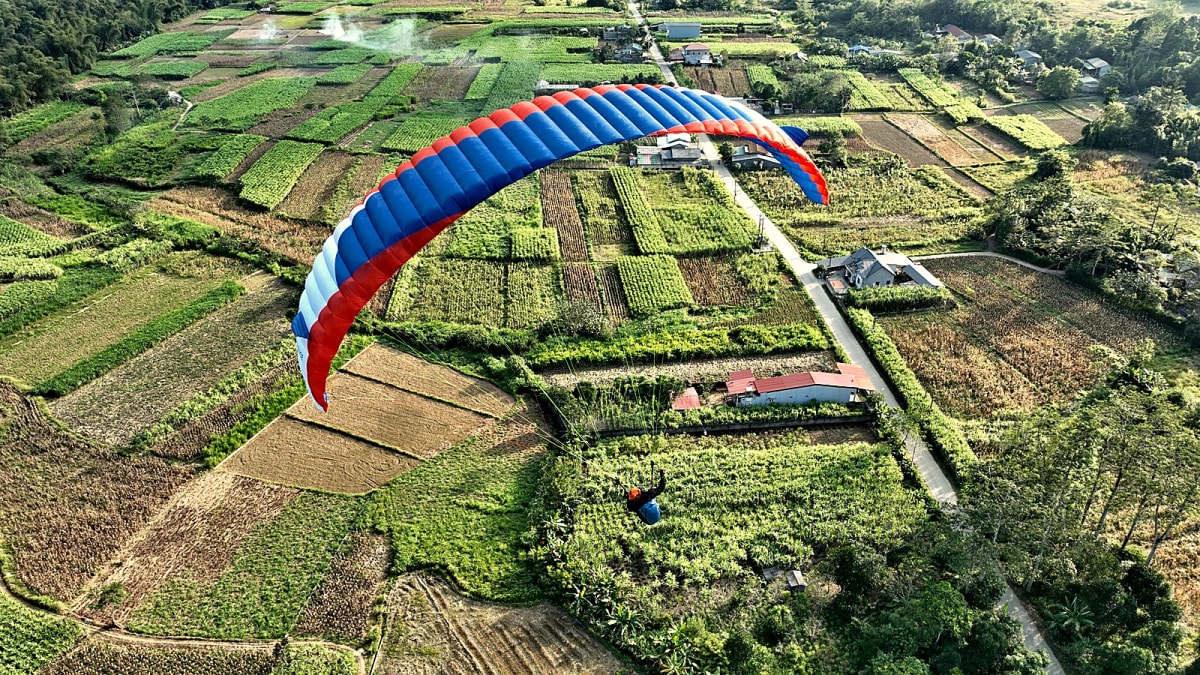
Then he gradually lost height, flying over the fields on the valley floor. From above, the plots of farmland sat side by side like squares of colour, with a small road running straight through the village.
Over the fields on the valley floor, near the landing field (22 November 2026).The drone follows the wing over the fields on the valley floor (22 November 2026).The last minutes of the flight, before turning in to land (22 November 2026).
Landing on the bank of the Miện River
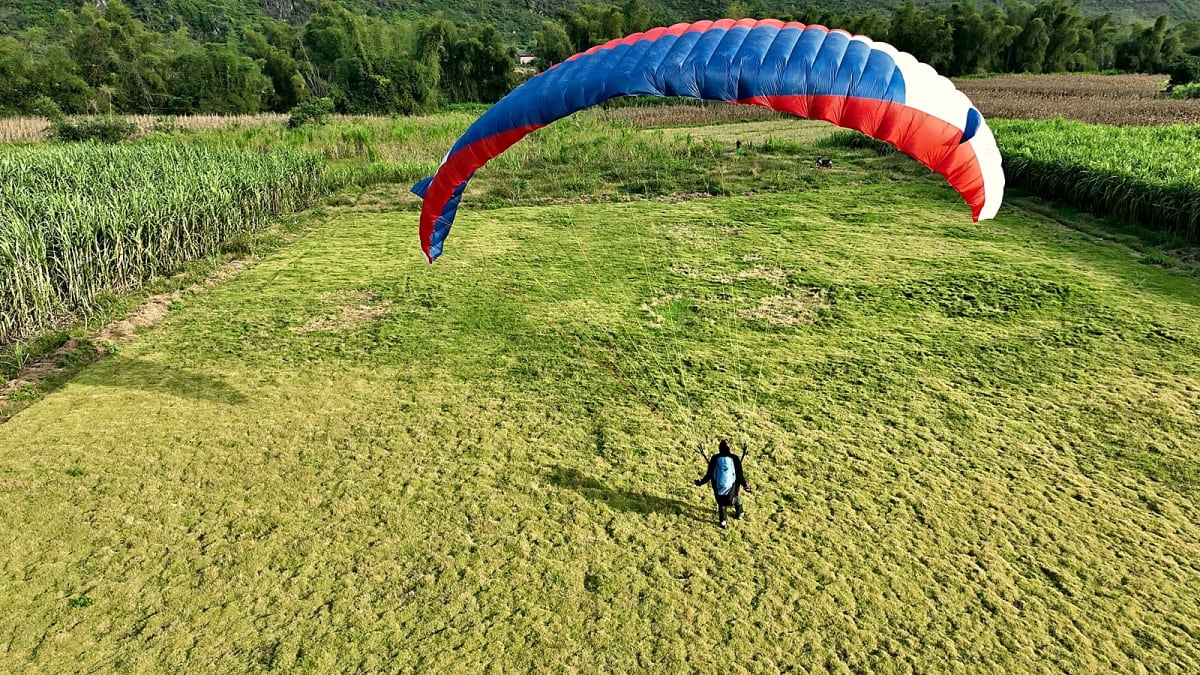
The landing field is a wide stretch of grass on the bank of the Miện River. Tài came down gradually and turned in to land into the wind, just as he had been taught. Close to the ground, he flared fully, pulling the brakes all the way to slow the wing, then touched down on both feet.
Tài comes in to the landing field on the bank of the Miện River and lands standing firmly on the grass (22 November 2026).Feet on the ground, wing still overhead (landing field on the bank of the Miện River, 22 November 2026).
After landing, he gathered up his wing, walked to the middle of the field and spread it out again to keep practising. For a student, every flight is a lesson, and so is every inflation on the grass.
What student pilots should know before flying at Quản Bạ
Quản Bạ is a paragliding site right on the Hà Giang Loop, between Hà Giang city and Yên Minh. If you have finished a beginner course and want to fly here like Tài:
Get in touch in advance so the Mebayluon pilots know your dates, your level and how many flights you have logged.
Bring suitable gear: an EN-A wing or a class that matches your level, a harness with a reserve, a helmet and a radio.
Listen to the site briefing: wind direction, the approach to the landing field and the areas to avoid.
Most people who learn to fly start with a tandem flight. Sitting in front of an experienced pilot, you get to feel what it's like to leave the ground and hang in the open sky, and find out whether you really want to take the brakes yourself.
Try a tandem flight at Quản Bạ: book online, no deposit needed.
Ask about the P1–P2 course at Quản Bạ or Khau Phạ pass on the hotline, or read the post P1–P2 paragliding course.
Frequently asked questions
Can I fly solo in Hà Giang once I've finished a beginner course?
Yes, if you have completed a beginner course and have suitable gear. For your first flights at a new site, fly when a pilot who knows the site is there, and stay in radio contact, as Tài did at Quản Bạ.
Which wing should a new pilot buy after the course?
Usually an EN-A wing, the easiest and most stable class to fly, like Tài's Advance Alpha 7. The wing size must match your total flying weight. Ask your instructor before you buy.
What is a reserve parachute for?
A reserve is an emergency parachute, packed inside the harness. A pilot only throws it if the main wing has a problem that can't be fixed in the air. Even if it has never been used, a reserve still has to be repacked at regular intervals.
Can I learn to fly without my own gear?
Yes. During the course, the school lends students their equipment. Only buy your own kit once you have finished the basics and know which wing suits you.
Book a flight:book online, no deposit, free rescheduling