Hanoi to Hà Giang: sleeper bus, limousine or self-drive?
Hanoi to Hà Giang is about 300 km, 6–7 hours: we compare sleeper buses, limousine vans and self-driving, how to choose a departure time, your first day in Hà Giang city, flying at Quản Bạ, then carrying on along the Loop and getting back.
Ms. Judy · · 16 min read
Hanoi to Hà Giang is about 300 km, roughly 6–7 hours by sleeper bus or limousine van. The most popular way is to take an overnight bus, arrive in Hà Giang city at dawn, then carry on 45 km up to Quản Bạ — the first stage of the Hà Giang Loop and home to the paragliding site.
This article compares the three main ways to get there — sleeper bus, limousine van and driving yourself — then suggests how to plan your first day in Hà Giang: rest in the city and visit the Km0 marker, or head straight up to Quản Bạ to fly and carry on along the Loop. At the end you'll find tips for the trip back, a packing checklist and the questions guests most often ask our flying team.
A quick note on names: since 1 July 2025, Hà Giang province has been merged into Tuyên Quang province. On maps and official documents you may see the name "Tuyên Quang", but bus companies, hotels and travellers still simply say "Hà Giang", and so does this article.
Comparing ways to travel Hanoi – Hà Giang
Transport
Time (approx.)
Pros
Cons
Sleeper bus
6–7 hours
Many departures, budget-friendly, sleep on board
Narrow berths, can be hard to sleep
Keep reading
Limousine van
6–7 hours
Wide seats, fewer passengers, smoother ride
Fewer departures, higher price
Self-drive car
6–7 hours
Flexible, use the car for the whole Loop
Tiring, you need to be used to mountain passes
Self-ride motorbike
A full day
A true road-trip experience
Exhausting before the Loop even starts
Fares and departure times vary by operator and by season, so this article doesn't list specific prices. Ask the bus company directly and book ahead, especially over public holidays and during buckwheat flower season (roughly October to early December), when visitor numbers in Hà Giang rise sharply.
Sleeper bus: the most popular choice
This is the most common way up, for Vietnamese and foreign travellers alike. Overnight buses usually leave Hanoi in the evening and reach Hà Giang city around dawn. You sleep on board, save a night's hotel and have the whole of the next day in Hà Giang.
A few things to know before you book:
Pick a lower berth if you get motion sickness. The lower deck sways less and is easier to get in and out of.
Bring a jacket and socks: the air conditioning on board is quite cold, especially on night buses.
Check the pick-up and drop-off points: some operators drop you at the bus station, others take you to your hotel in the city. If you've already booked a room or arranged a car up to Quản Bạ, give the address to the bus company when you book.
Keep what you'll need in a small bag on your berth: a warm layer, a power bank, water and motion sickness tablets. Large suitcases usually go in the luggage hold and are hard to get at along the way.
Sleeper berths are fairly narrow, so tall people or light sleepers may find the ride tiring. If you know you struggle to sleep on buses, consider a limousine van, or take a daytime bus and spend a night in the city.
Limousine van: smoother, good for families
Limousine vans have reclining seats or small cabins, carry fewer passengers and usually offer door-to-door pick-up and drop-off. The seats are wider and the ride is smoother, which makes them a good fit for families with young children, older travellers or anyone who wants to be better rested before starting the Loop.
The trade-off is fewer departures and a higher fare than the sleeper bus, so book early for weekends and peak season. The journey takes about the same time as a sleeper bus, around 6–7 hours.
Driving yourself by car
If you drive your own car, head from Hanoi towards Tuyên Quang, then follow National Road 2 up to Hà Giang. Some stretches now have expressways that shorten the journey. The big advantage is freedom: you use the same car for the whole Loop and stop for photos wherever you like.
If you're driving:
Once you reach Hà Giang, the Loop roads are narrow, steep and full of mountain passes. The driver should be used to mountain roads, and the car's brakes should be checked carefully before the trip.
Avoid driving the passes at night. In November and December it gets dark early (sunset is around 17:15–17:30), so plan to reach your overnight stop before dark.
Early mornings up high can be foggy: drive slowly and keep your lights on.
Spending a night in Hà Giang city before the Loop is safer than driving straight from Hanoi onto the mountain passes in one go.
Riding a motorbike from Hanoi?
Some people ride a motorbike all the way from Hanoi for the full road-trip experience. But it takes a whole day, and you'll be worn out before you reach the most beautiful passes. What most people do instead is take a bus up to the city, then rent a motorbike or hire an easy rider there. Read our article easy rider or self-ride motorbike to pick the option that suits your riding skills.
Which departure time should you choose?
Choose your bus based on what you want to do on your first day:
Want to paraglide the very next morning? Take an overnight bus, arrive in Hà Giang city at dawn, rest and have breakfast, then head up to Quản Bạ.
Want an afternoon or sunset flight? You can still take the night bus, catch up on sleep in the city in the morning and go up to Quản Bạ after lunch.
Can't sleep on buses? Take a daytime bus, spend a night in the city and start the Loop the next morning.
Whichever you choose, leave yourself some slack. Buses can run late because of road conditions or weather.
Arriving in Hà Giang city
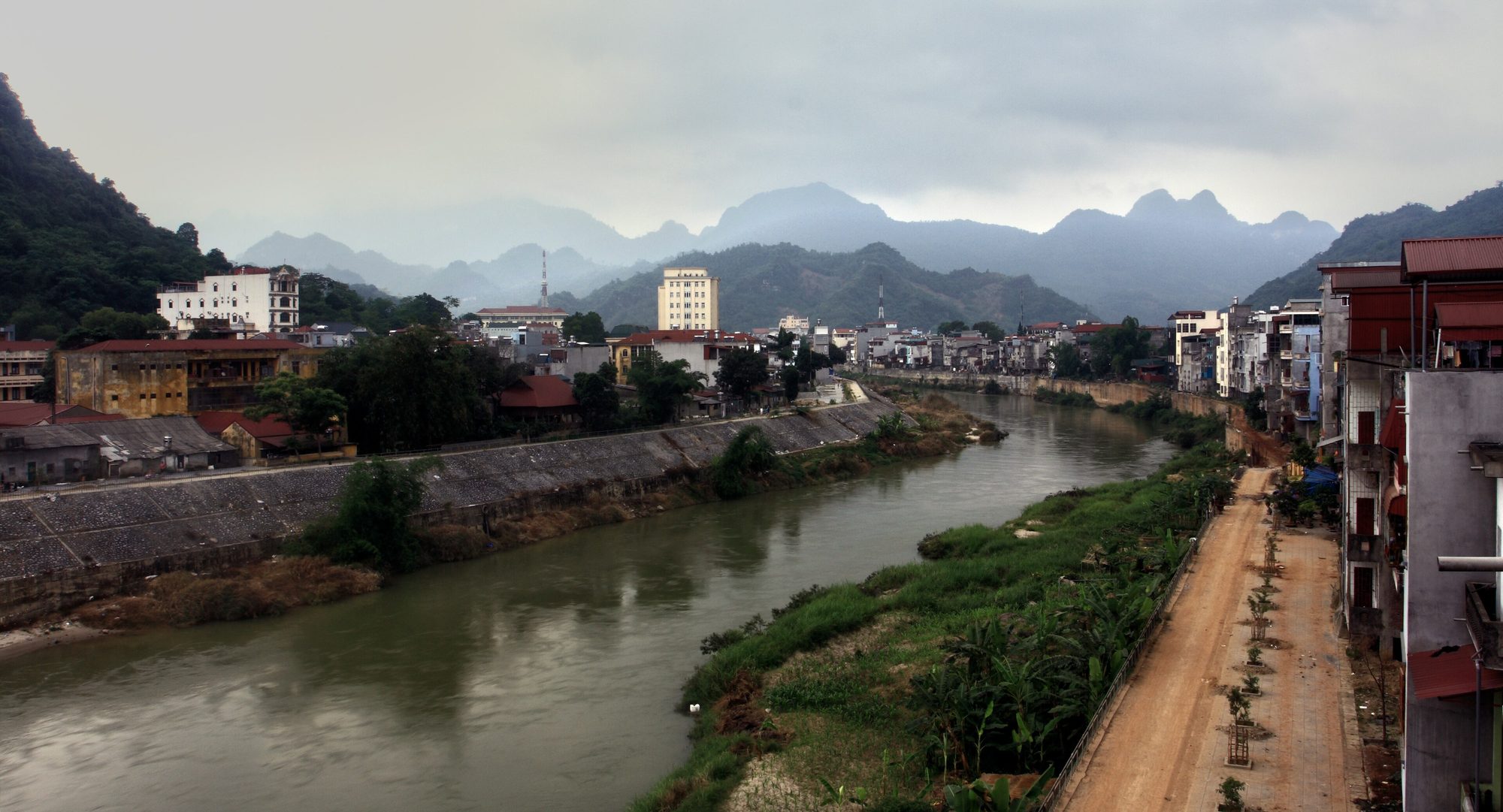
The Lô River running through Hà Giang city, with mountains beyond — Photo: Idan Robbins, CC BY-SA 4.0, Wikimedia Commons
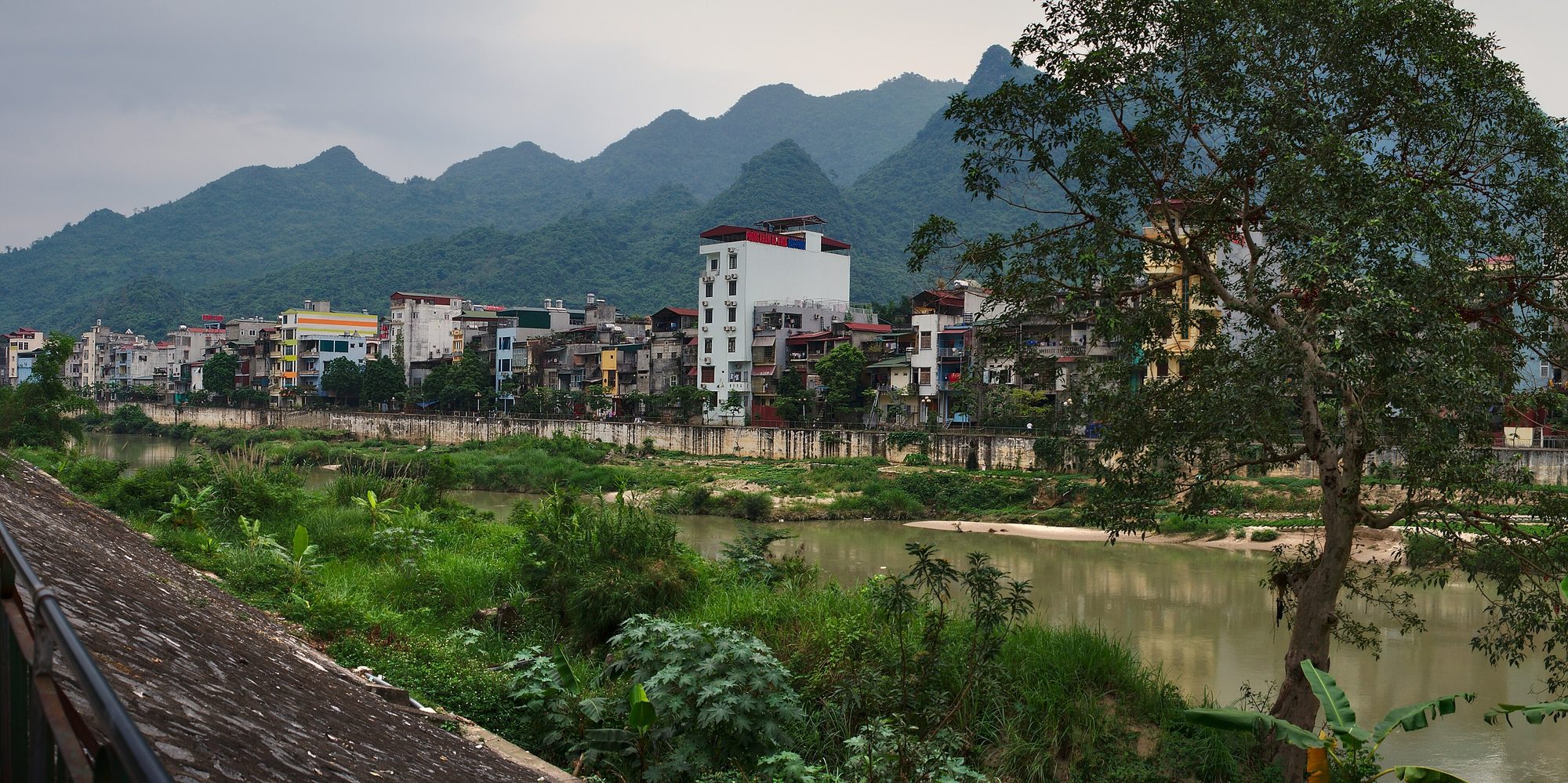
Hà Giang city sits on both banks of the Lô River and is the starting point of the Hà Giang Loop. On a night bus you'll usually get off while it's still dark or just getting light. Head to your hotel or homestay to drop your bags and freshen up, then go for breakfast. Bánh cuốn with egg (steamed rice rolls) is the city's classic breakfast, and a hot plate of it is just right on a cool early morning.
The city is also the easiest place to get ready for the Loop: rent a motorbike, meet your easy rider, take out cash, buy a light raincoat or gloves. Further up the Loop, shopping won't be nearly as convenient. See also our Hà Giang city stage guide.
Your first day: two ways to plan it
Option 1: rest in the city, visit Km0, then go up to Quản Bạ
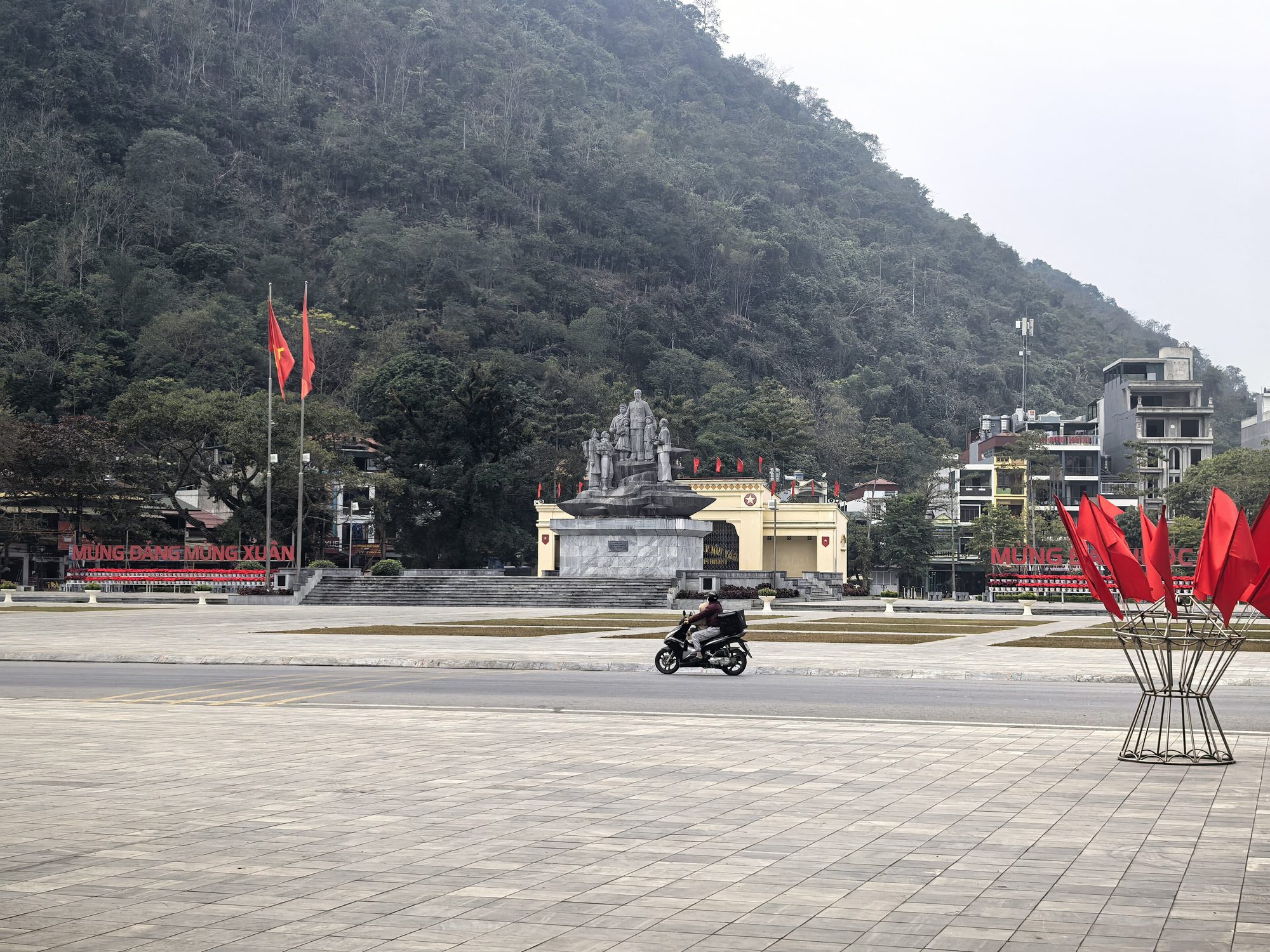
The central square of Hà Giang city — Photo: HuangWending18072009, CC0, Wikimedia Commons
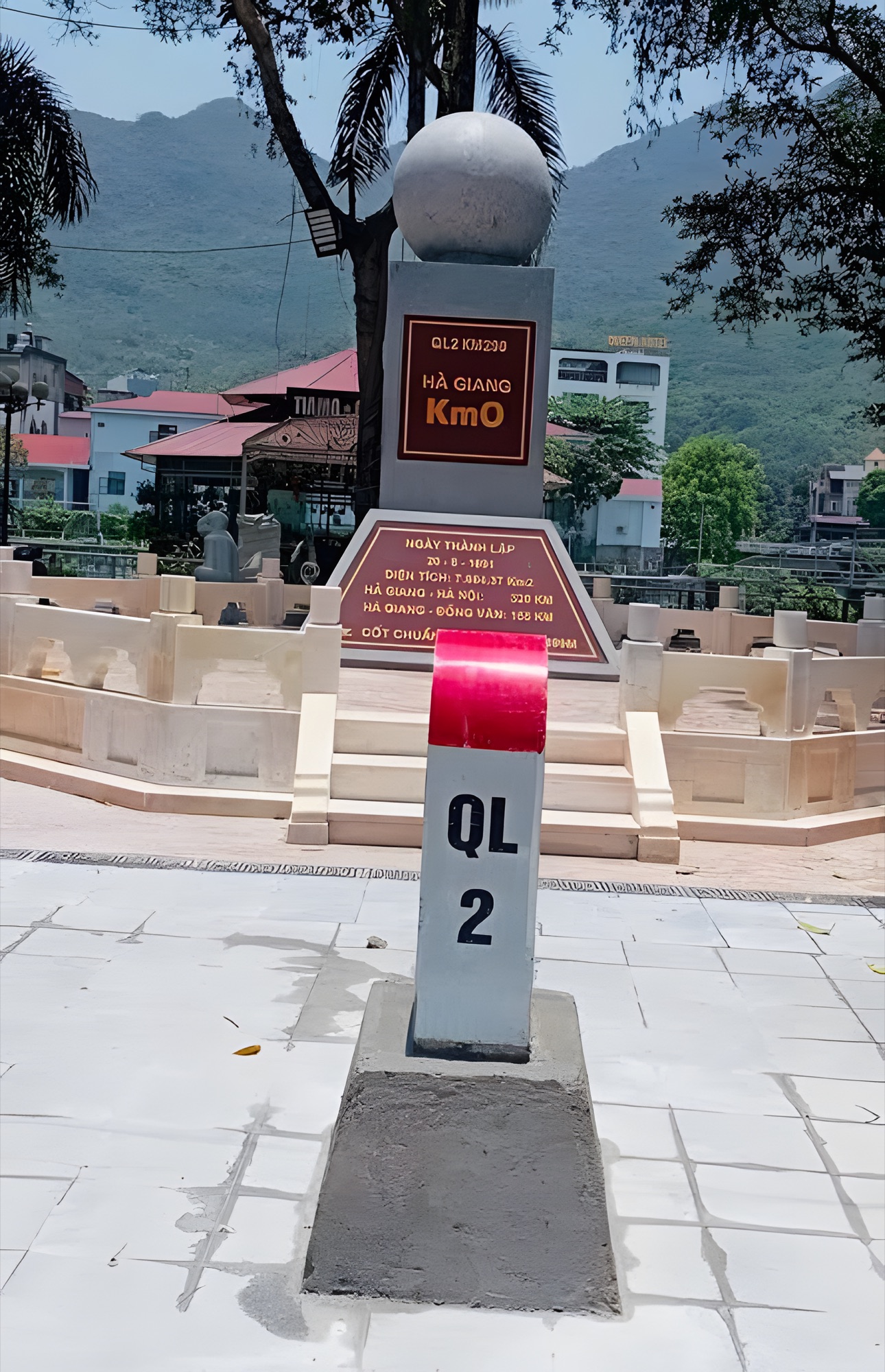
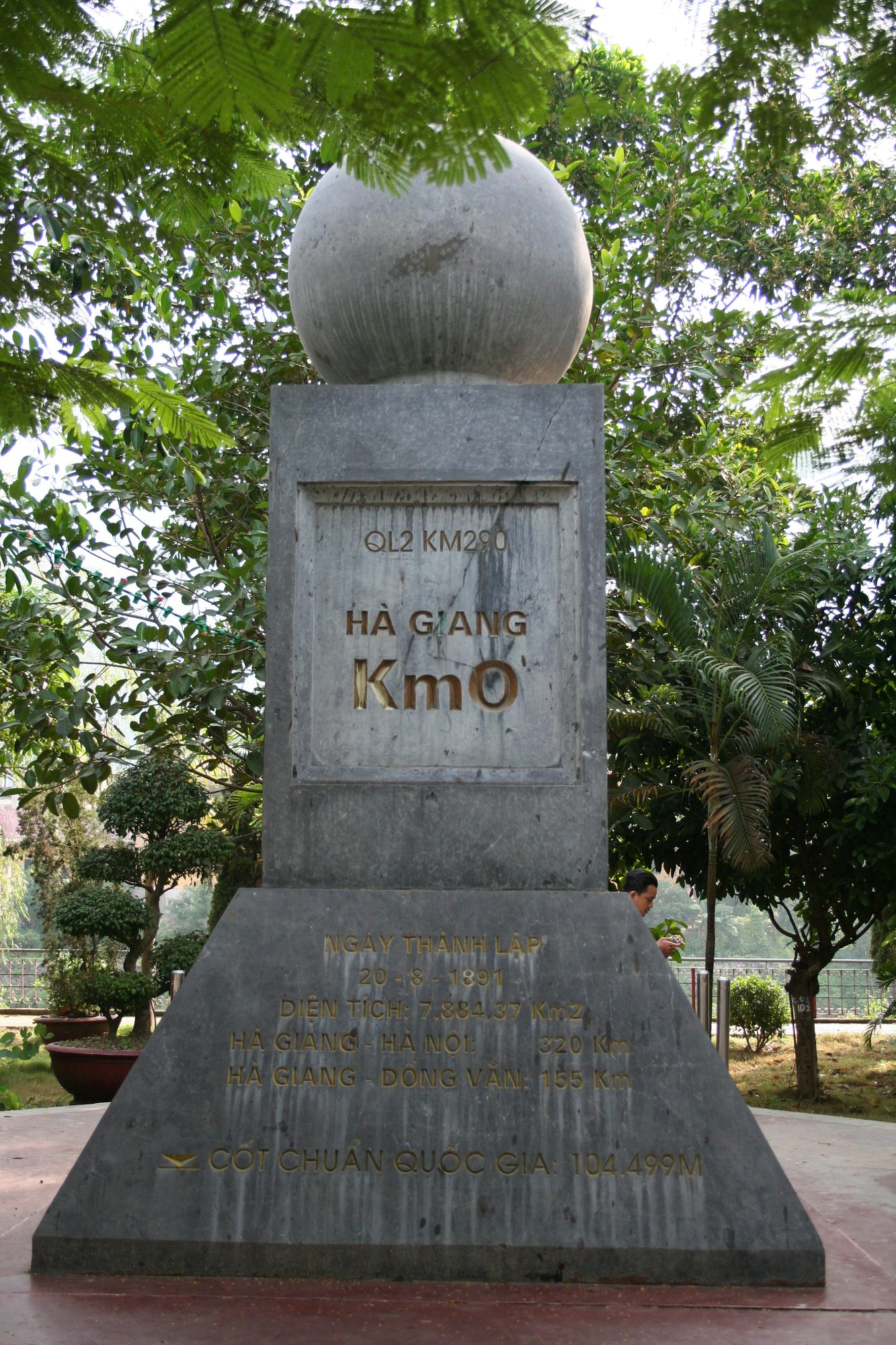
This suits people who didn't sleep well on the bus, families with young children, or anyone who prefers a slower pace. Catch up on sleep in the morning, then take a stroll around the centre: the square, the banks of the Lô River and the Km0 marker — the photo stop almost everyone on the Loop makes.
The Km0 marker in Hà Giang city — Photo: Thái Nhi, public domain, Wikimedia Commons
In the afternoon you can head up to Quản Bạ (about 45 km) for an afternoon or sunset flight, then stay the night in Quản Bạ or go back to the city. If you'd rather take it easy, save the flight for the next morning, on your way out onto the Loop.
Option 2: off the night bus and straight up to Quản Bạ to fly
Many guests want to make the most of their first morning. A sample schedule:
Time (approx.)
What you do
4:00–5:00
The sleeper bus arrives in Hà Giang city. Rest, freshen up, have bánh cuốn with egg for breakfast
6:00
Set off for Quản Bạ
7:30–9:30
Paragliding or paramotor flight over the Miện river valley
Afterwards
Continue the Loop or go back to the city to rest
If you didn't sleep well on the bus, move your flight to a later slot in the morning or to the next day. Flying tired and short on sleep is not a good idea. Rescheduling is free, so there's no need to push yourself.
From Hà Giang city up to Quản Bạ
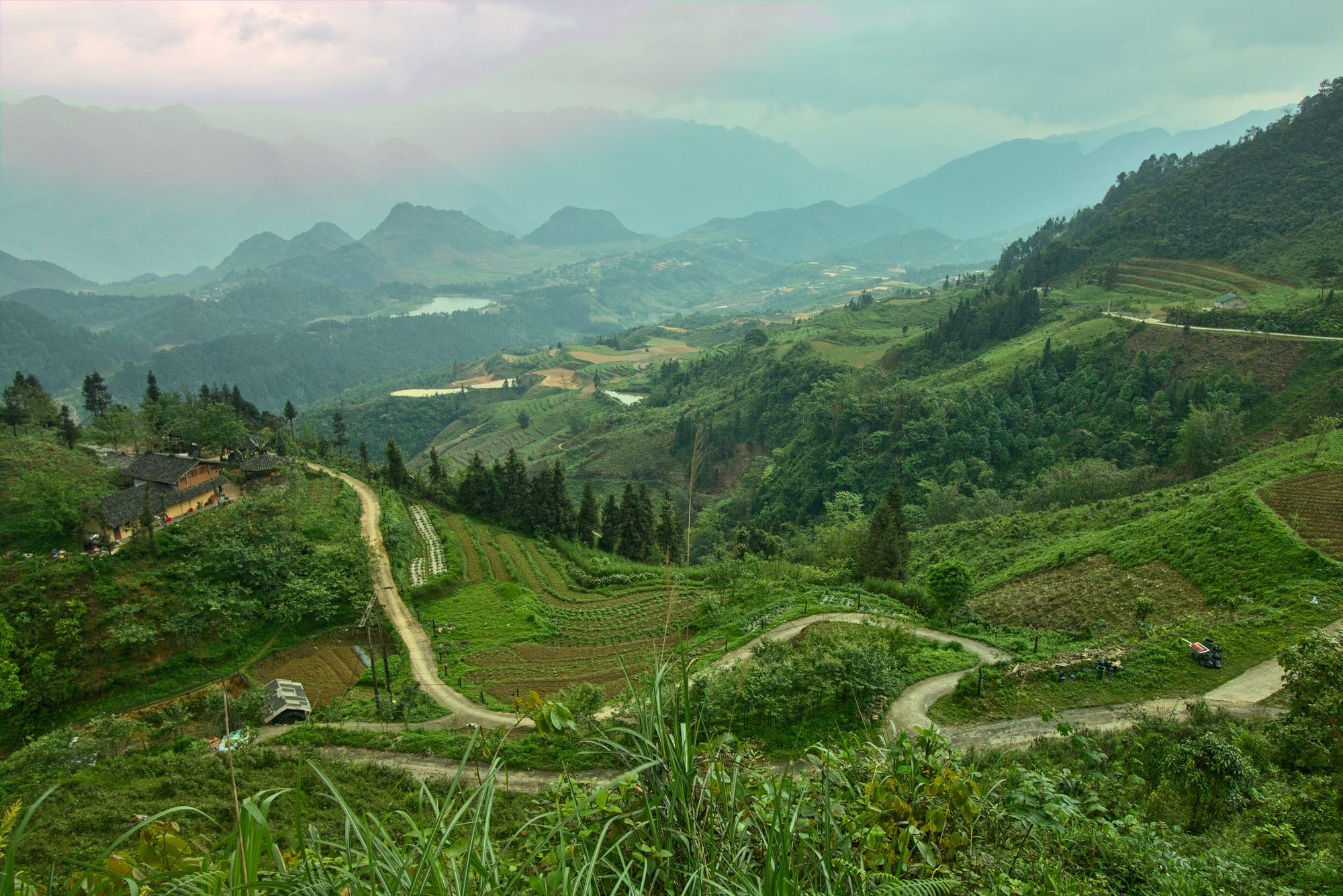
A winding road and terraced slopes in the hills of Quản Bạ — Photo: Benjamin Smith, CC BY-SA 4.0, Wikimedia Commons
Quản Bạ is about 45 km from the city along Highway 4C (QL4C), roughly 1 hour 15 minutes. This is the first stretch of the Hà Giang Loop: the road starts to climb, crosses Quản Bạ Heaven Gate and then drops into the valley with the Fairy Twin Mountains (Cô Tiên). There are three ways to get there:
Rent a motorbike or hire an easy rider in the city and start the Loop right away. Quản Bạ is the natural first stop; after your flight you just ride on.
Take the Hà Giang – Đồng Văn / Mèo Vạc bus and get off at Tam Sơn.
Our team's private 4-seat car:500,000 VND per car per direction (≈ US$ 20), with pick-up from your hotel in Hà Giang city, selectable when you book. The price is per car, so split between 3–4 people it works out quite cheap.
If you're staying in the Quản Bạ area — Nậm Đăm, Cán Tỷ, Lùng Tám or Tam Sơn — transfers to and from the flying site are included in the ticket price. Detailed directions to the take-off and landing fields are in our article how to get to the Quản Bạ flying site.
If you're driving yourself, the Heaven Gate section has lots of bends. Go slowly, give way to larger vehicles and only stop for photos where the road is wide and well clear of a bend.
Flying at Quản Bạ: what you need to know
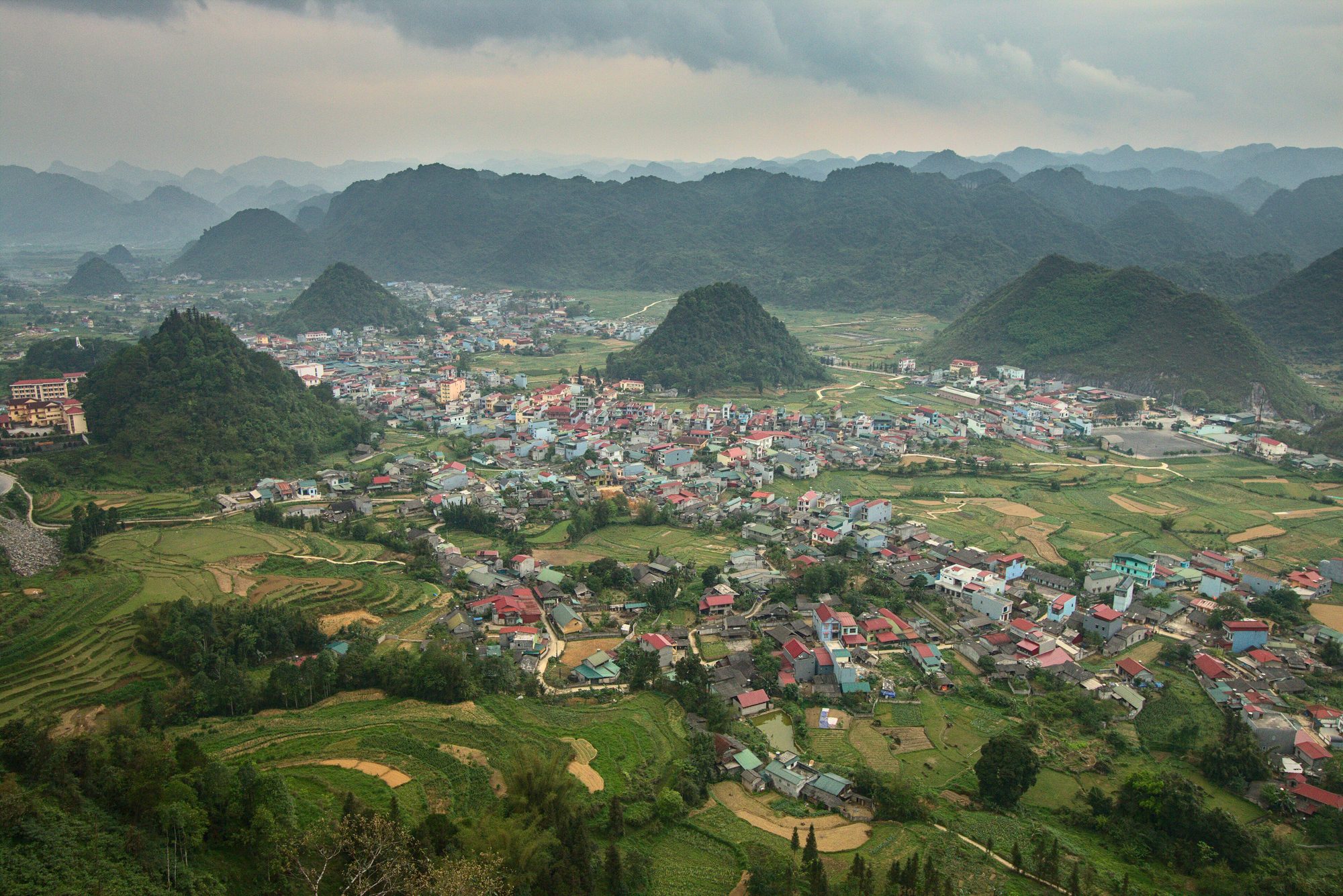
The Quản Bạ valley with its town and cone-shaped hills, seen from above — Photo: Benjamin Smith, CC BY-SA 4.0, Wikimedia Commons
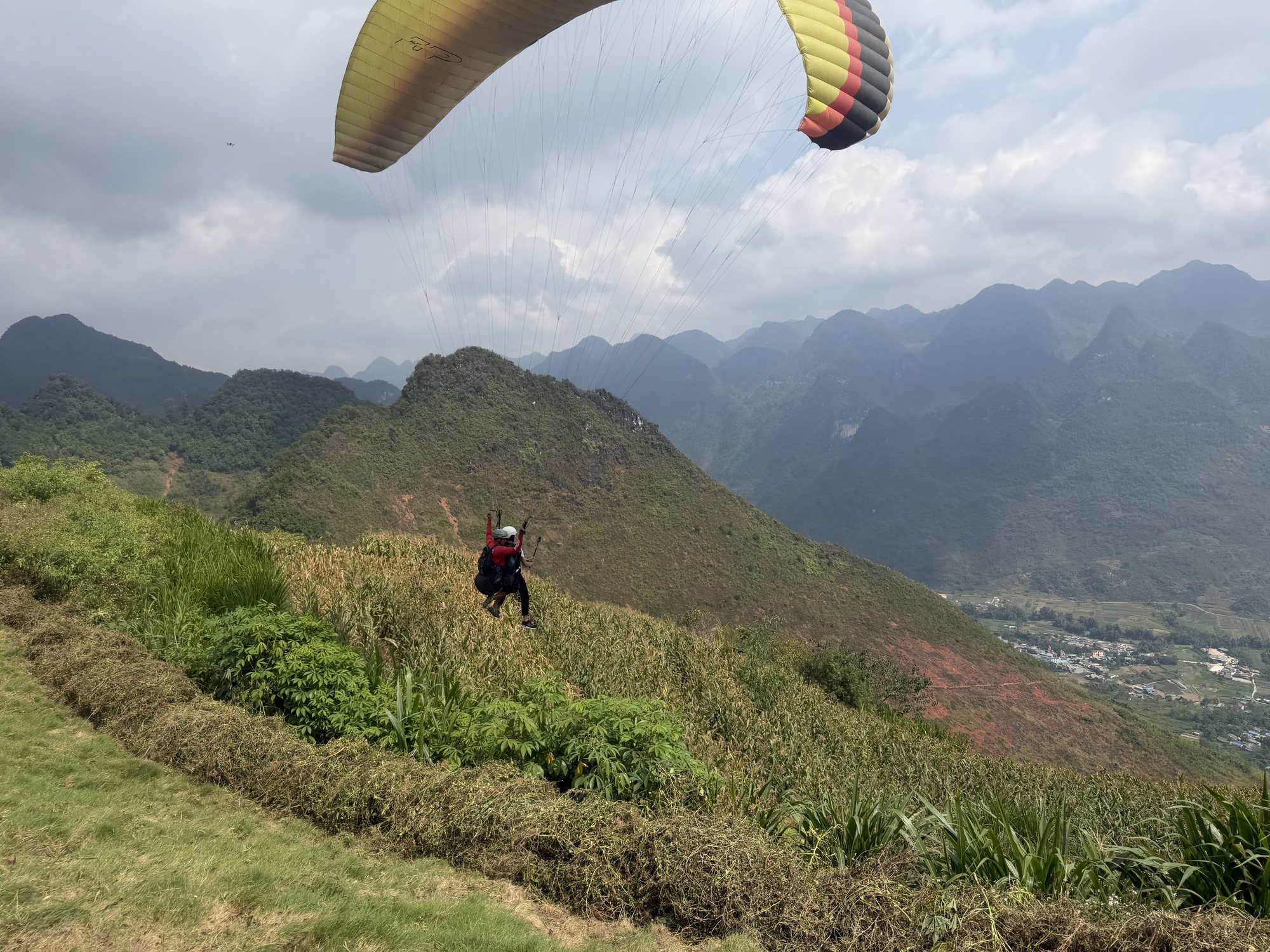
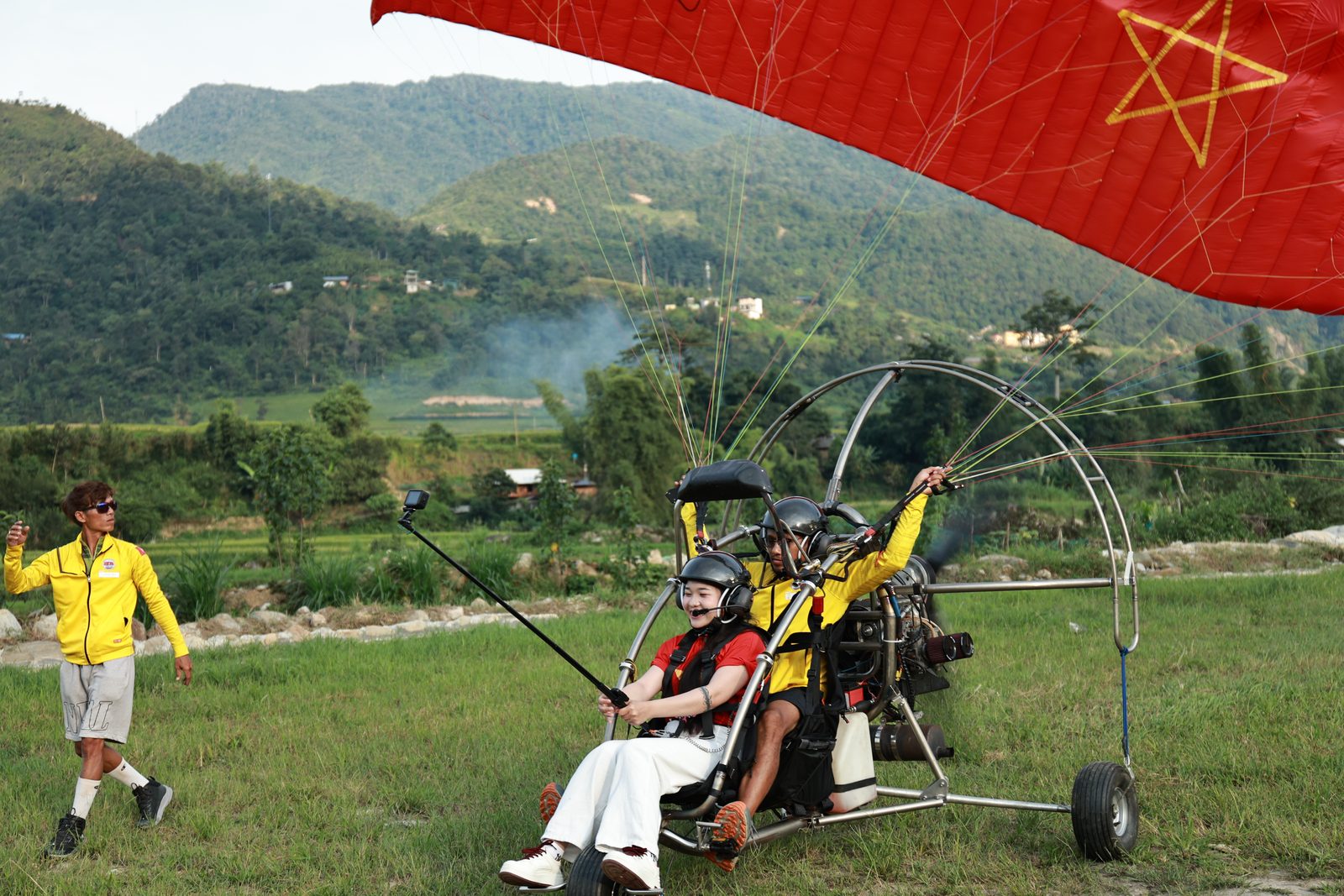
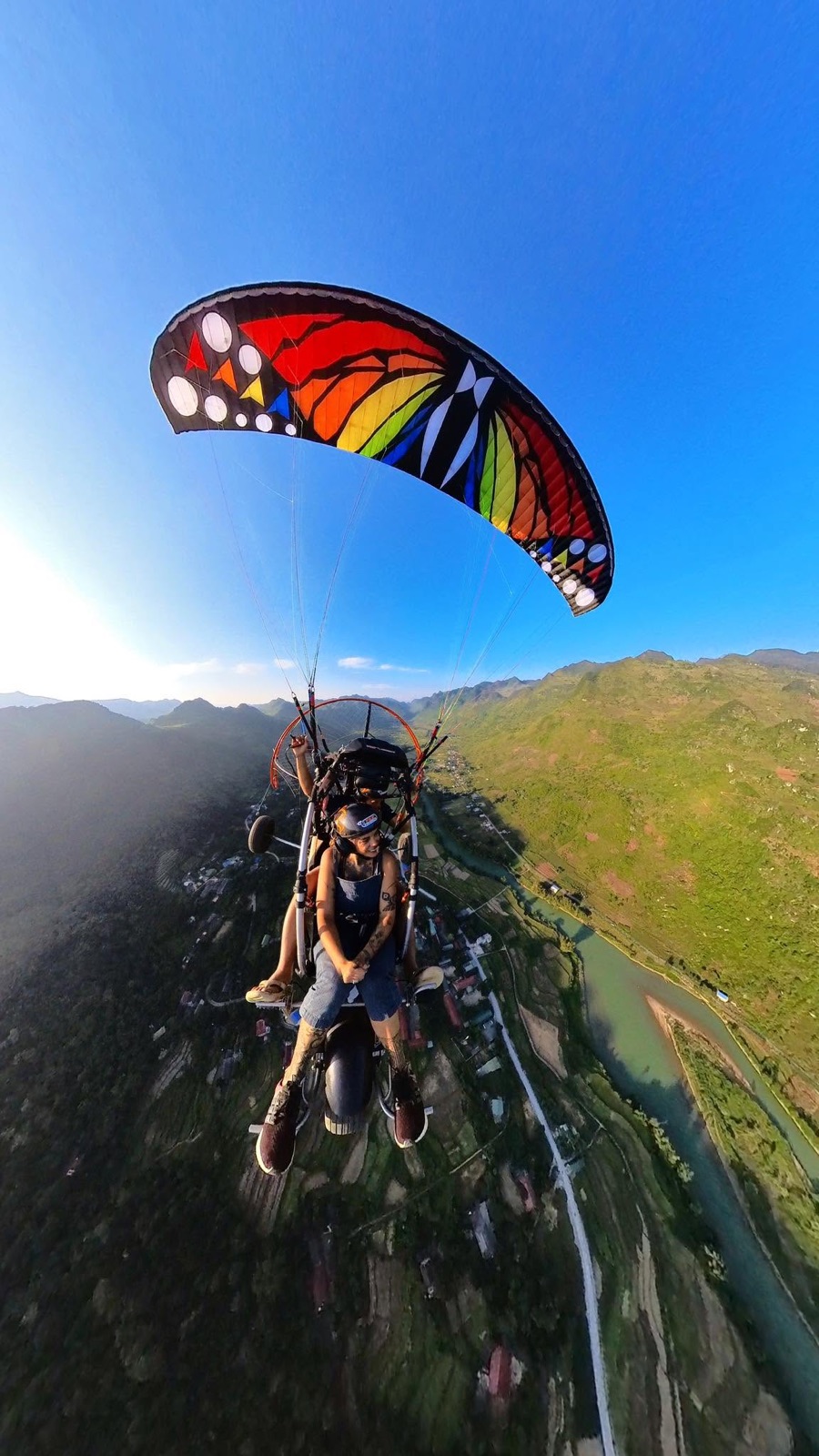
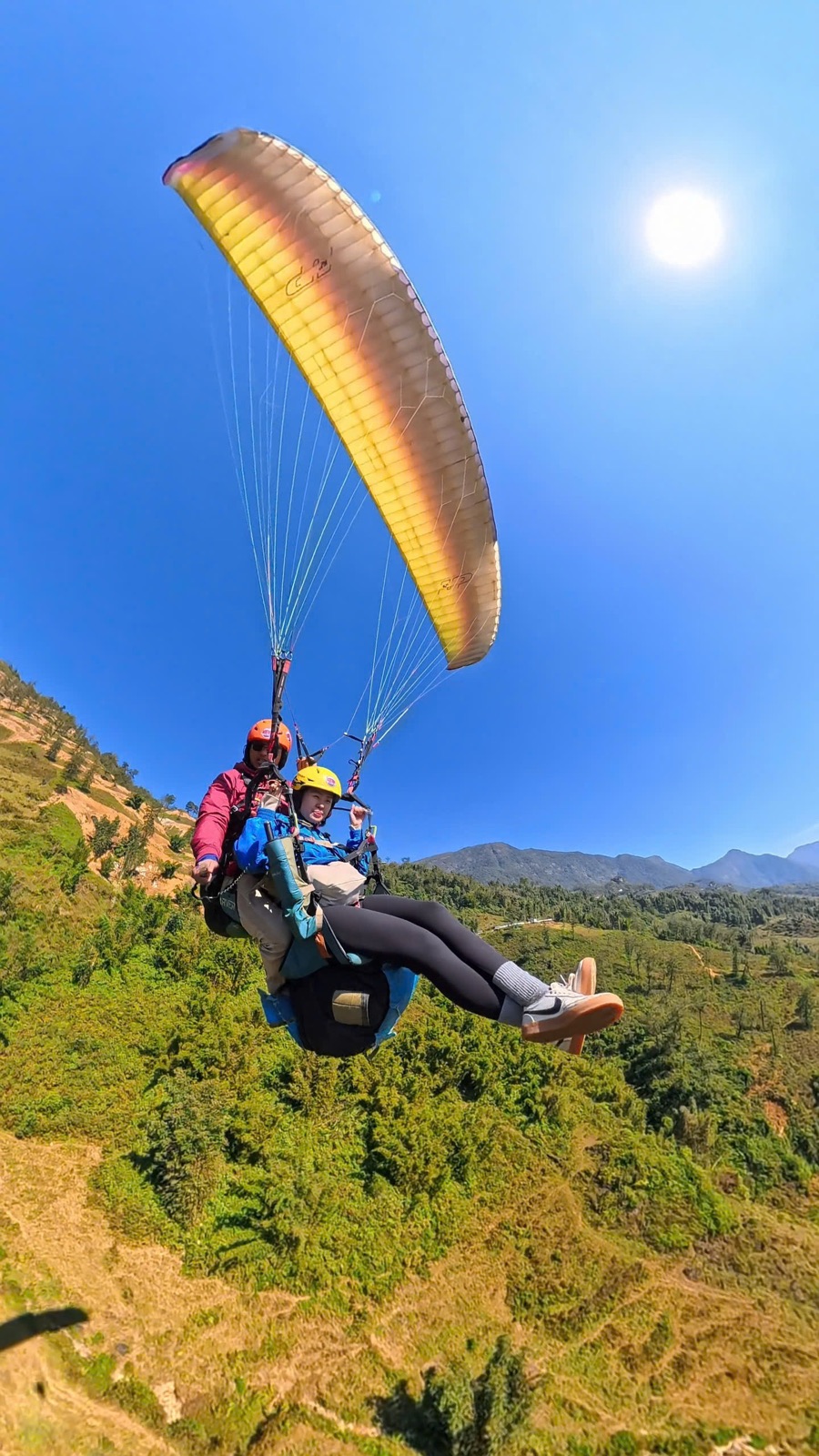
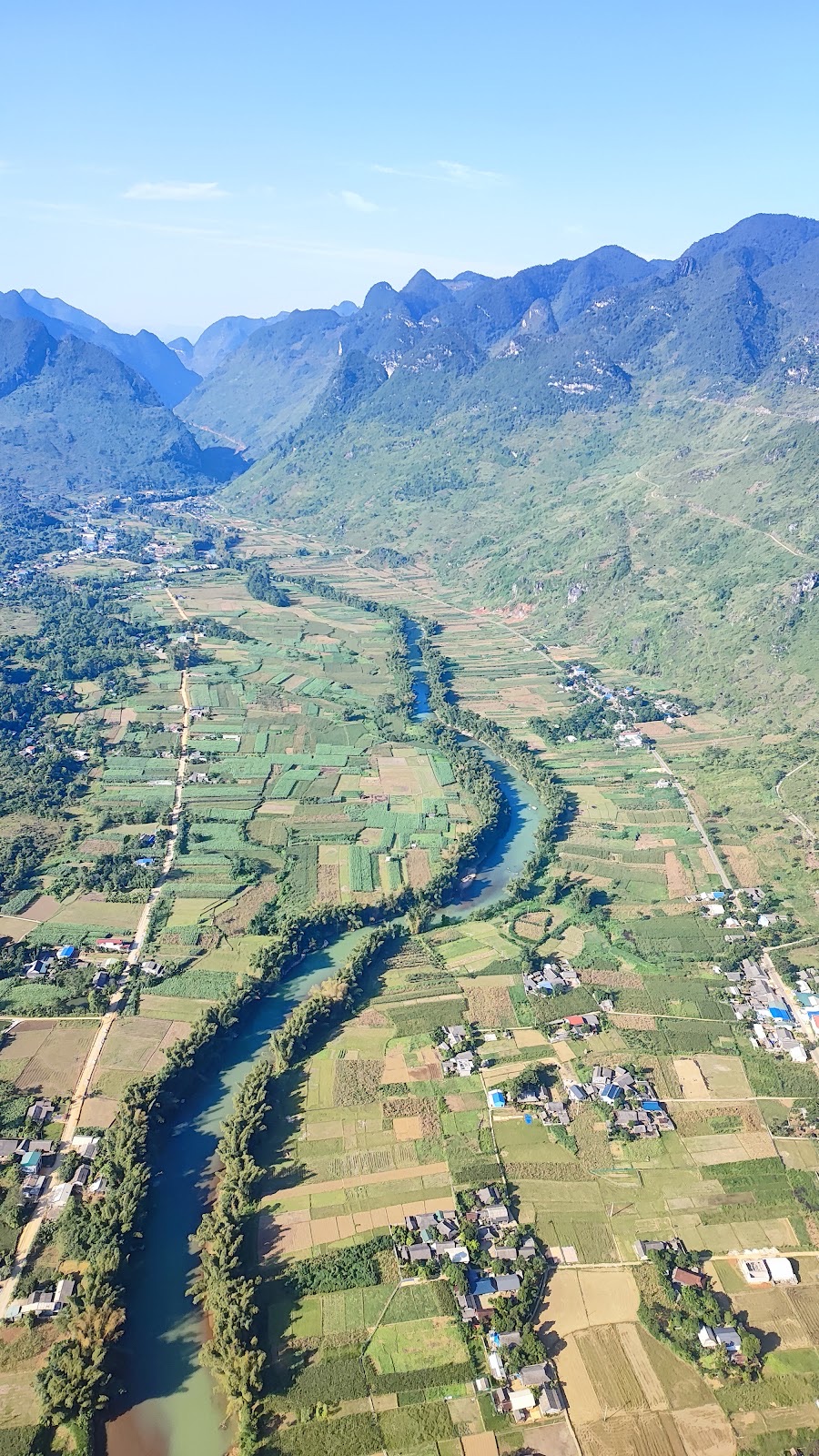
The Quản Bạ flying site is at around Km45 of the Loop and is open every day, 06:30–18:30. Tandem paragliders take off with a short run down a mountain slope at about 950 m and land in the wide, flat valley beside the Miện river, at about 450 m. Paramotors (powered paragliders) take off straight from the flat field down in the valley, next to the Miện river. From up there you can see the Fairy Twin Mountains, Quản Bạ Heaven Gate, jagged "cat's-ear" limestone peaks, maize fields and the Miện river winding around the valley.
Prices include a free GoPro video (just ask your pilot), insurance and drinking water. Drone footage and a 360° camera are optional extras at 400,000 VND (≈ US$ 16) per guest each.
Sunrise and cloud-chasing flights are paramotor only. If conditions don't allow a special flight, it becomes a standard flight.
No deposit and nothing to pay when you book — you pay at check-in on the day, before your flight.
If you're a group, book together in one go to get an automatic discount: groups of 3 get 50,000 VND (≈ US$ 2) off per guest, groups of 4 or more get 70,000 VND (≈ US$ 3) off per guest.
The tandem wing leaves the slope and heads out over the Quản Bạ valley
You don't need any experience; children from 3 years old can fly tandem with a pilot. If you weigh over 90 kg, please let us know in advance. If you have a heart condition, are pregnant, have recently had surgery or have a history of epilepsy, tell the flying team when you book. Be at the flying site about 30 minutes before your flight time.
Flights only go ahead when the wind and visibility are safe. The team watches the forecast and confirms flight times on the morning of the flying day; you can also check for yourself on our flying weather forecast page. If the weather doesn't allow flying, rescheduling is free — which is also why it's worth flying early in your trip, so you still have spare days.
After your flight, carry on along the Hà Giang Loop
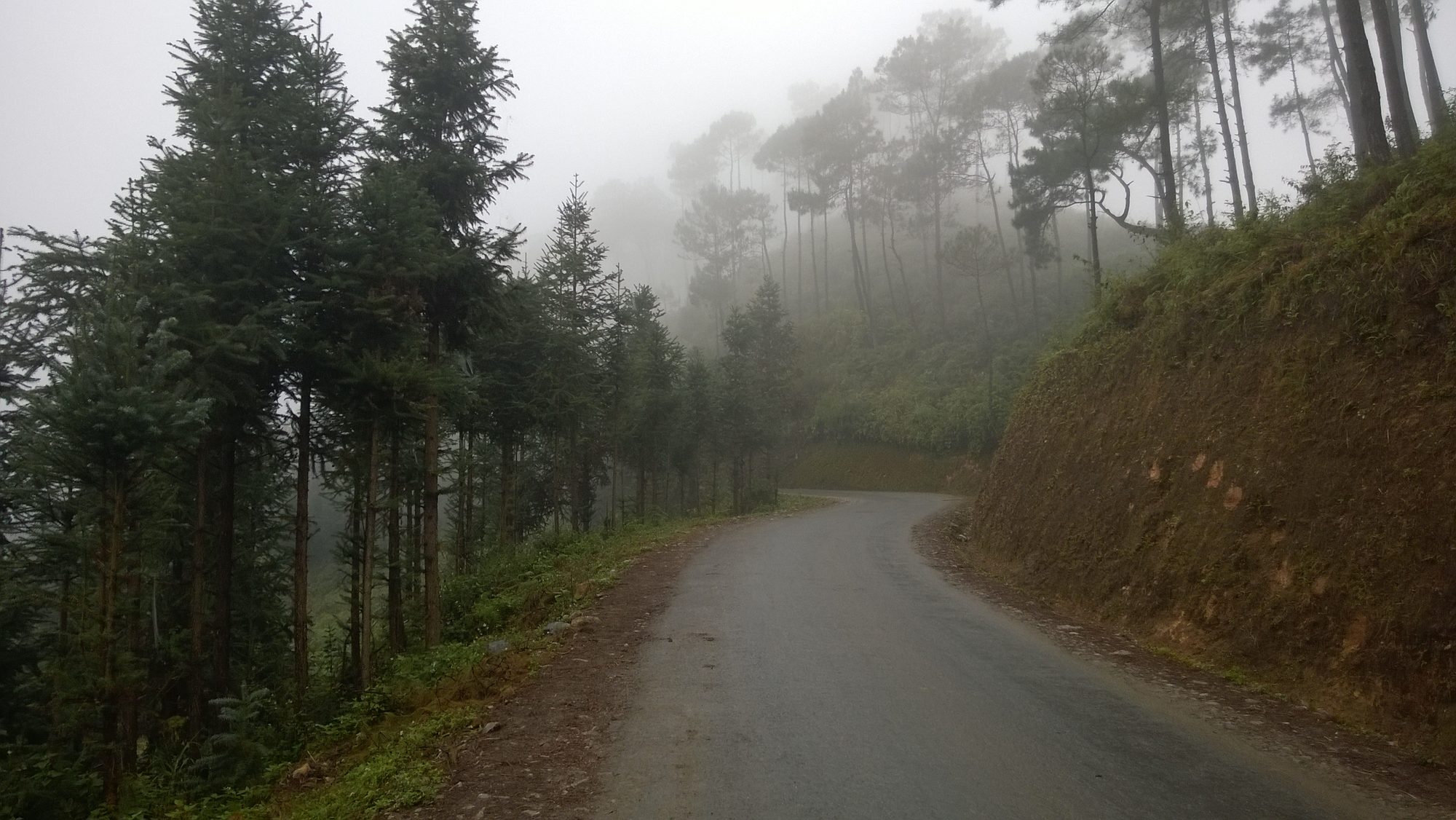
A road through misty conifer forest in Yên Minh district — Photo: Vuong Tri Binh, CC BY-SA 4.0, Wikimedia Commons
A morning flight at Quản Bạ is a very neat way into the Loop: you're already on the route, so once you've landed you can have lunch and ride on. The next stage is Yên Minh, with roads through pine forest that are often misty early in the morning. After that come Đồng Văn (around Km150), the Mã Pí Lèng pass and Mèo Vạc (around Km185).
A few tips for linking your flight with the Loop:
Don't fly late and then ride the passes after dark. Days are short at the end of the year; if you fly in the afternoon, stay the night in Quản Bạ rather than pushing on. Accommodation ideas are in our article where to stay in Quản Bạ.
Dress warmly. Mornings and evenings up on the plateau are cold — in November and December it's often only around 5–15 °C, and Đồng Văn is colder still. A windproof jacket and lace-up trainers work both for flying and for riding.
Fancy a second flight? Đồng Văn offers tandem paragliding over the old quarter and the Rocky Plateau, but there's no fixed daily schedule — you'll need to get in touch and book ahead as a group.
If you don't have an itinerary yet, take a look at our Hà Giang Loop 4 days 3 nights plan; whichever schedule you follow, try to fit your flight into the first day, when you pass through Quản Bạ.
Getting back to Hanoi
Riverside houses along the Lô River in Hà Giang city — Photo: Sketyl none, CC BY 2.0, Wikimedia Commons
For the return trip you have the same choices as on the way up: sleeper bus, limousine van or driving yourself. Ask the bus company about departure times and pick-up points, and book ahead if you're travelling back at the weekend or over a holiday.
Leave plenty of time to get back to the city. Don't book your bus to Hanoi too close to the end of your last stage; mountain roads can be slower than you expect.
Didn't get to fly on the way up? If your route back passes through Quản Bạ, you can fly on the morning of your last day and then head back to the city for your bus. Quản Bạ is only about 45 km from the city.
Return your rented motorbike at the agreed place and remember to collect any documents you left as a deposit (if any).
Checklist before boarding the bus in Hanoi
National ID card or passport, needed to check in and to rent a motorbike.
A motorbike licence if you plan to ride the Loop yourself.
A warm jacket, a light raincoat and lace-up trainers (also the right shoes for flying).
Motion sickness tablets if you're prone to it.
A power bank and cash.
Your flight confirmation: date, time slot and pick-up point.
If you're not sure of your arrival date, you can still book your flight in advance to hold a spot, then let us know if your bus is late or you'd like an extra night in the city. Rescheduling is free.
Frequently asked questions
How long does it take from Hanoi to Hà Giang?
About 6–7 hours by sleeper bus or limousine van for the roughly 300 km journey, depending on the operator and road conditions. Riding a motorbike usually takes a full day.
Is it a good idea to take the night bus and fly the next morning?
Yes, if you can sleep on the bus. If you're tired, choose a later flight slot or fly the next day so you're in the best shape.
Does the team pick up from the Hà Giang bus station?
The private car service picks up from hotels in Hà Giang city, 500,000 VND (≈ US$ 20) per 4-seat car per direction. If you'd like to be picked up somewhere else in the city, add a note when you book or call the hotline.
Is there a bus from Hà Giang city up to Quản Bạ?
Yes. The Hà Giang – Đồng Văn / Mèo Vạc buses pass through Quản Bạ; get off at Tam Sơn. From there, if you're staying in the Quản Bạ area, transfers to and from the flying site are included in the ticket price.
Should I fly at Quản Bạ at the start or the end of my trip?
Fly early, right as you start the Loop. If the weather doesn't allow flying that day, you still have the following days to reschedule for free, instead of having no spare days left.
Book a flight:book online — no deposit, free cancellation
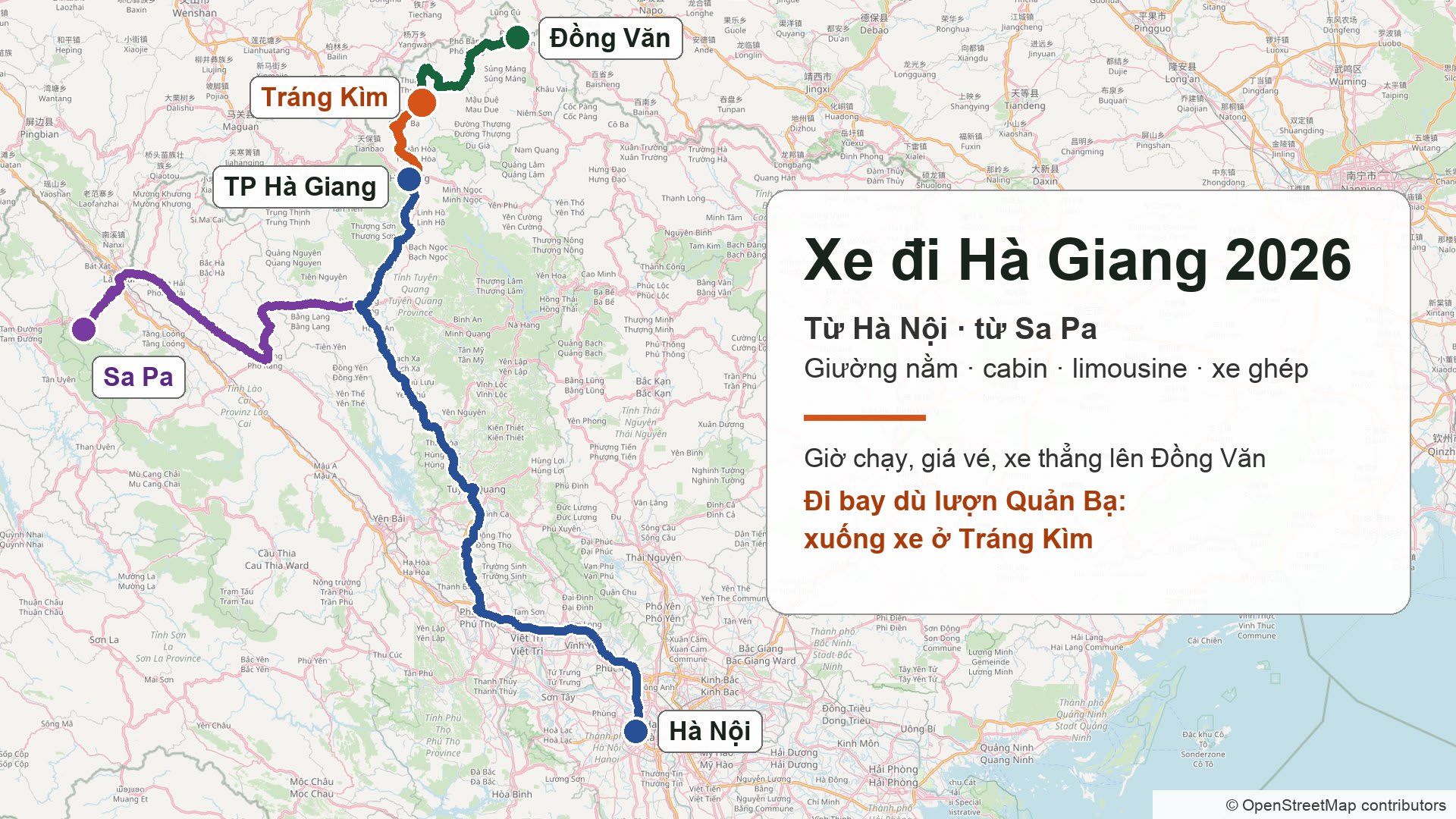
A round-up of buses to Hà Giang in November 2026: from Hà Nội (21 operators; sleeper, cabin, limousine and shared car; direct buses to Đồng Văn; pick-ups at IC3–IC9) and from Sa Pa (6 operators, return trips included), plus a few routes from other provinces. Timetables and fares, and where to get off for paragliding at Quản Bạ (Tráng Kìm)…
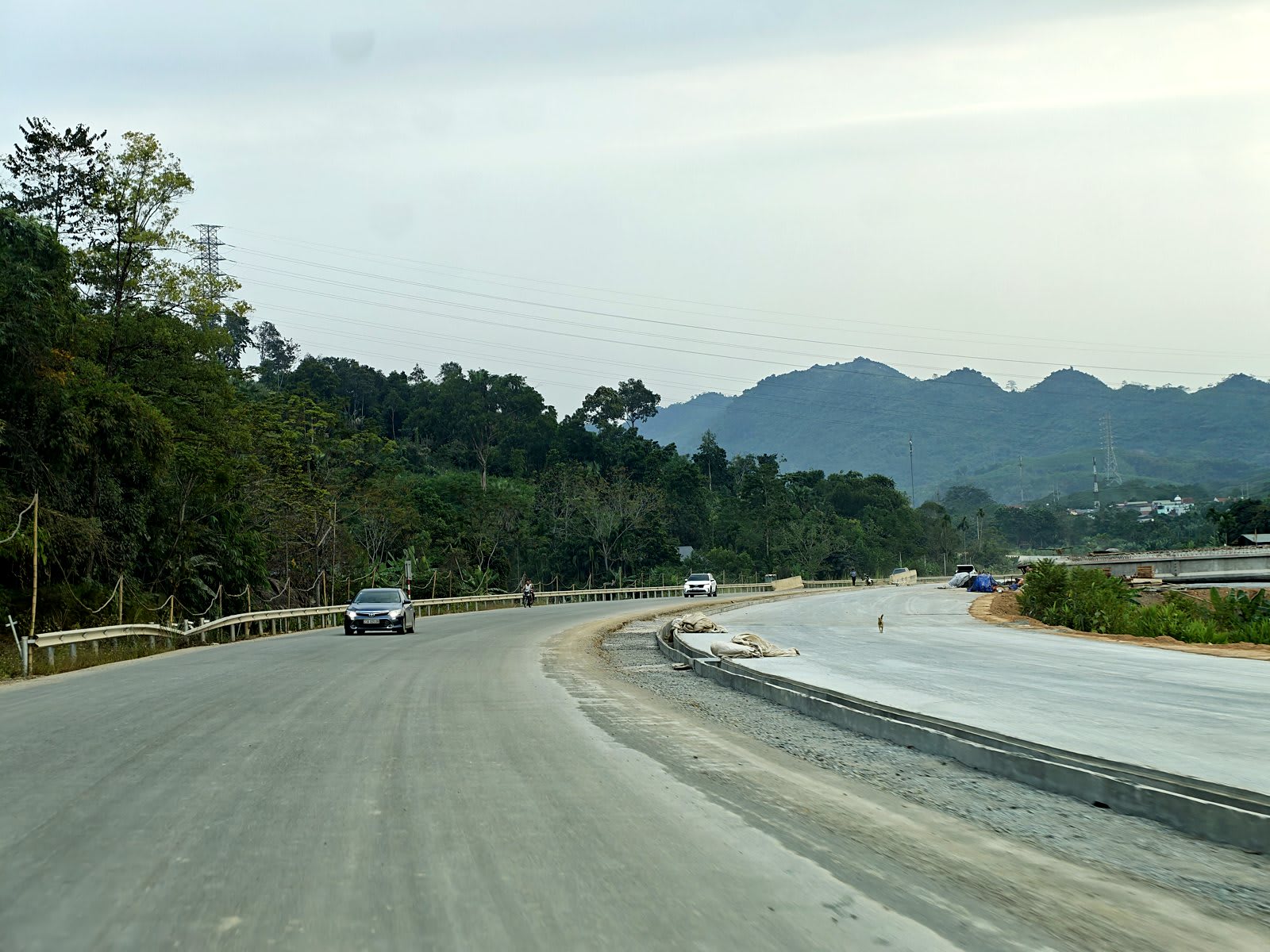
On the afternoon of 2 November 2026 we test-drove the CT.15 expressway from the QL279 junction (Bắc Quang) to Hàm Yên: about 70% drivable, many temporary barriers, asphalt still being laid, dirt service roads, no lights or signs. A temporary half-road opening is still a few months away; the full route needs at least 6–12 months. Photos, map, project figures and whether to use it…
How far from Quản Bạ centre, and where to turn, to reach the 950 m paragliding take-off and the 450 m landing field by the Miện River, which is also the paramotor take-off. With a 3D map, coordinates and the distance of each leg…
Hà Giang paragliding and paramotor prices for 2026 in Quản Bạ: standard package from 2.290.000đ, cloud-chasing and sunset packages, drone, 360 camera, transfers, group discounts and how paying at check-in before your flight works…
Paragliding is engine-free flight under a soft fabric wing, powered by wind and rising warm air. A simple explanation of how the wing flies, what a tandem flight is, and the experience in Hà Giang…
The Quản Bạ flying site is about 45 km from Hà Giang city along QL4C. We compare motorbike, bus and the flight team's 4-seat car, plus the meeting point and when to arrive…